
Best Virtual Care Vital Signs Tools for Large Health Systems
A procurement-focused ranking of the selection criteria that matter most when health systems evaluate virtual care vital signs tools at enterprise scale.
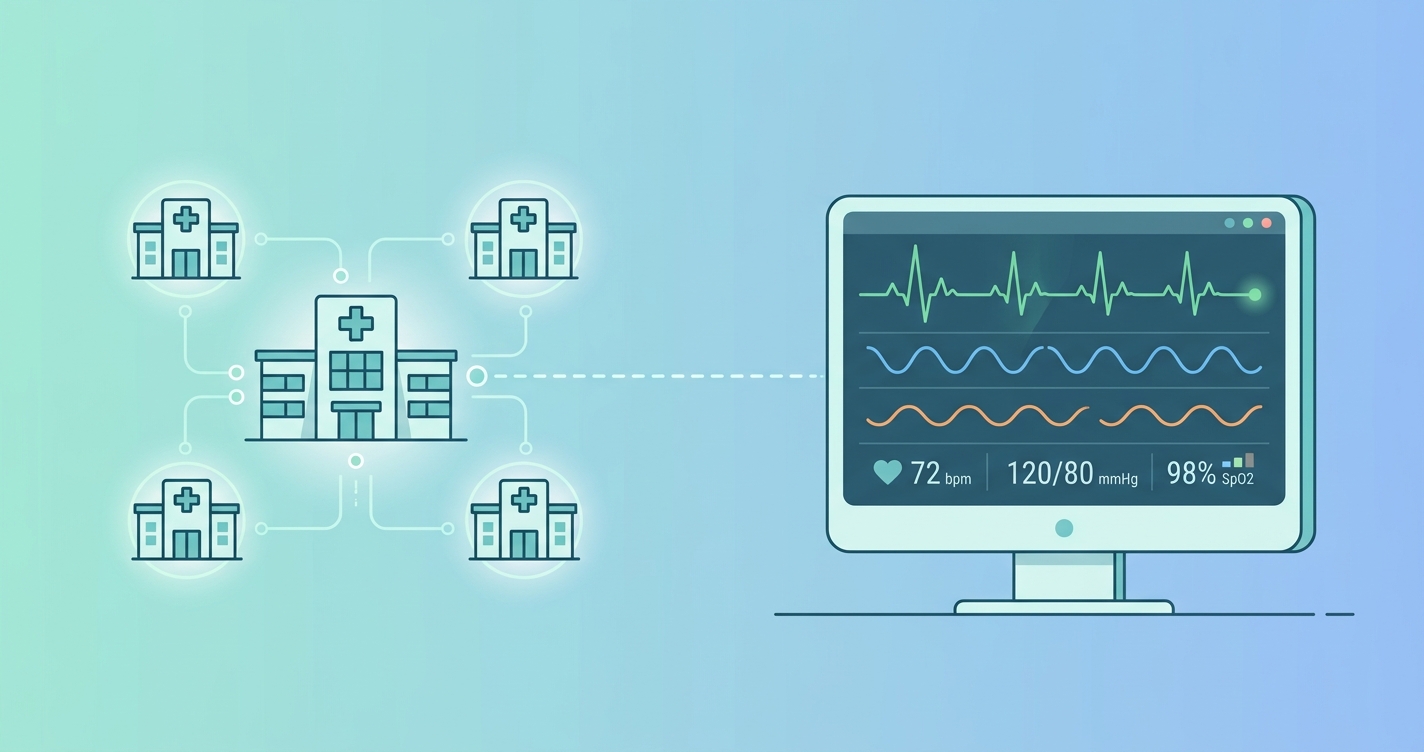
Procurement teams at large health systems no longer evaluate virtual care technology the way they did during the first wave of telehealth expansion. The video channel is a solved problem. What separates a strategic purchase from a stranded one is whether the platform can put trustworthy clinical data into the encounter and into the medical record. That shift has moved virtual care vital signs tools from a niche add-on to a board-level procurement question, and the criteria for choosing among them now look more like an enterprise software evaluation than a point-solution trial.
"The integration of telehealth with EHRs is becoming a basic requirement rather than a competitive advantage.", Best Telehealth Platforms for 2024 buyer analysis, 2024
This guide ranks the selection criteria that experienced clinical informatics teams weigh most heavily, then frames them against the realities of a multi-site, multi-specialty deployment.
How to rank virtual care vital signs tools for enterprise scale
When a health system evaluates virtual care vital signs tools, the decision rarely turns on a single feature. It turns on how a tool behaves under load, across populations, and inside existing clinical workflows. The most common failure mode is buying for a pilot and discovering the architecture cannot scale to a full enterprise footprint. A scalable virtual vitals solution has to satisfy four interlocking requirements at once: clinical credibility, EHR interoperability, deployment breadth, and operational governance.
A useful way to organize an evaluation is to score candidates against weighted criteria rather than a flat checklist. The weighting below reflects what health system CIOs and virtual care program directors tend to prioritize once a tool moves past initial screening.
| Selection Criterion | Why It Matters at Enterprise Scale | Suggested Weight | | --- | --- | --- | | Clinical credibility and validation evidence | Determines whether clinicians will trust and act on remote measurements | High (25%) | | Bidirectional EHR integration | Avoids manual transcription, supports billing and longitudinal records | High (25%) | | Deployment model and patient access | No-hardware capture widens eligible patient population dramatically | Medium-High (20%) | | Security, compliance, and data governance | HIPAA posture, encryption, and audit trails are non-negotiable | Medium-High (15%) | | Scalability across specialties and sites | Single contract must serve primary care, behavioral health, specialty | Medium (10%) | | Vendor support and implementation depth | Determines time-to-value and clinical adoption rates | Medium (5%) |
The weighting is a starting point. A behavioral health-heavy system might raise the value of stress and heart rate variability capture, while a rural network might weight patient access even higher because device distribution is impractical.
Key qualifiers that separate enterprise-ready tools from pilot-grade ones:
- Capture that works without patient-owned wearables or peripheral devices, since hardware logistics collapse at scale.
- Structured data output that maps to standard vitals fields rather than free text or PDF attachments.
- Documented performance across skin tones, lighting conditions, and motion, which are the known limits of camera-based methods.
- A governance model that lets clinical leadership control when and how remote vitals are used in decision-making.
Industry applications across a health system
A single enterprise contract has to serve clinical contexts that have very different tolerances for measurement and very different workflows. The strongest enterprise telehealth vitals software handles this variation without forcing each service line into a separate tool.
Primary care and chronic disease management
Primary care drives the largest virtual visit volume, and blood pressure, heart rate, and respiratory rate anchor most chronic disease follow-up. Here the priority is throughput and EHR fidelity. A measurement that never reaches the flowsheet is operationally invisible, so the integration pattern matters as much as the measurement itself.
Behavioral Health
Behavioral health televisits benefit from physiological context that the conversation alone cannot supply. Heart rate variability and stress indicators captured passively during a session give clinicians an objective signal alongside subjective report. Because these visits are almost always remote and rarely involve any peripheral device, camera-based capture fits the modality cleanly.
Specialty and post-acute follow-up
Specialty clinics increasingly run longitudinal virtual follow-up for cardiology, pulmonology, and post-discharge monitoring. The requirement shifts toward trend reliability over time and the ability to flag deterioration between in-person encounters. A health system vitals platform that captures consistent measurements across repeated visits supports this far better than one-off readings from inconsistent home devices.
Nursing triage and access points
Triage nurses work from symptom descriptions that are hard to weigh without numbers. Adding objective vitals at the triage stage helps route patients to the right level of care and reduces unnecessary escalation. At enterprise scale, this means the tool has to integrate into the access and scheduling layer, not just the provider visit.
Current research and evidence
The underlying science for camera-based capture is remote photoplethysmography, or rPPG, which extracts pulsatile signals from subtle color changes in facial skin recorded by a standard camera. A 2024 review published in the Journal of Personalized Medicine (MDPI) summarized recent advances in rPPG for vital sign monitoring and identified the parameters most consistently recoverable from video, including heart rate and respiratory rate, while flagging motion artifact, lighting variation, skin tone, and perfusion as the principal accuracy challenges that vendors must engineer around.
Procurement teams should treat that research as a checklist for due diligence. The same 2024 review noted that standardized validation protocols are still maturing, which means buyers cannot assume that two products tested under different conditions are comparable. That places the burden on the health system to ask for population-specific evidence rather than aggregate accuracy claims.
On the integration side, the 2024 buyer analyses of enterprise telehealth platforms are consistent: bidirectional EHR integration has crossed from differentiator to baseline expectation. Health systems evaluating virtual care vital signs tools in 2024 and beyond are advised to prioritize deep, two-way EHR connectivity and a scalable architecture capable of handling high volumes across multiple specialties and care settings. The practical implication is that a vitals tool which cannot write structured data back to the record will struggle to justify enterprise spend regardless of how good its capture is.
A few evidence-driven evaluation practices worth building into a request for proposal:
- Require validation data stratified by skin tone and lighting, not a single headline accuracy figure.
- Ask for the specific EHR write-back mechanism and the data standard used, such as discrete flowsheet mapping.
- Request references from deployments of comparable scale and specialty mix.
- Confirm how the tool behaves when signal quality is poor, since silent failure is worse than a flagged failure.
The future of virtual care vital signs tools
The direction of travel points toward vitals capture becoming an invisible layer inside the visit rather than a separate step. As rPPG models improve their robustness across the conditions identified in the 2024 literature, the friction of measurement should keep dropping, which expands the eligible patient population without expanding hardware logistics. For a scalable virtual vitals solution, that matters more than any single accuracy gain, because access and adoption ultimately determine clinical impact at the system level.
The second trend is governance maturation. As remote vitals enter more clinical decisions, health systems are formalizing the rules for how they are used, who reviews them, and when a flagged reading triggers escalation. Tools that expose configurable governance controls will fit this future better than closed black boxes. Expect procurement scorecards to add an explicit governance and auditability line within the next few cycles.
The third trend is consolidation of capture into the platforms clinicians already use. Standalone vitals apps create yet another login and another data silo. The enterprise-ready future favors capture embedded directly in the virtual visit workflow with native EHR write-back, which is precisely the architecture pattern the 2024 enterprise telehealth analyses recommend.
Frequently asked questions
What is the single most important criterion when selecting virtual care vital signs tools? For most large health systems it is a tie between clinical credibility and bidirectional EHR integration. A measurement clinicians do not trust will not be used, and a measurement that does not reach the record creates manual work that breaks at scale. Both should carry the highest weight in an evaluation.
Do enterprise virtual vitals tools require patients to own devices? Not necessarily. Camera-based approaches using rPPG capture vital signs from a standard device camera without peripherals, which removes the hardware distribution problem that makes device-dependent models difficult to scale across a large population.
How should a health system validate accuracy claims during procurement? Ask for validation evidence stratified by skin tone, lighting, and motion conditions rather than a single aggregate figure, and request references from deployments of similar scale and specialty mix. The 2024 rPPG literature notes that validation protocols are not yet standardized, so comparability cannot be assumed.
Can one platform serve primary care, behavioral health, and specialty clinics? A genuinely scalable virtual vitals solution should. The differentiator is whether the tool adapts to each service line's workflow and data needs from a single contract, rather than requiring separate point solutions per department.
Circadify is building toward this enterprise standard with camera-based, EHR-integrated vital signs capture designed for virtual visits across an entire health system. To review clinical workflows and walk through a procurement-ready evaluation, request a health system demo and clinical workflow review.