
Camera-Based Clinical Vitals vs Wearable Devices Compared
A side-by-side comparison of camera-based clinical vitals vs wearables on accuracy, cost, and adoption for health system informatics teams.
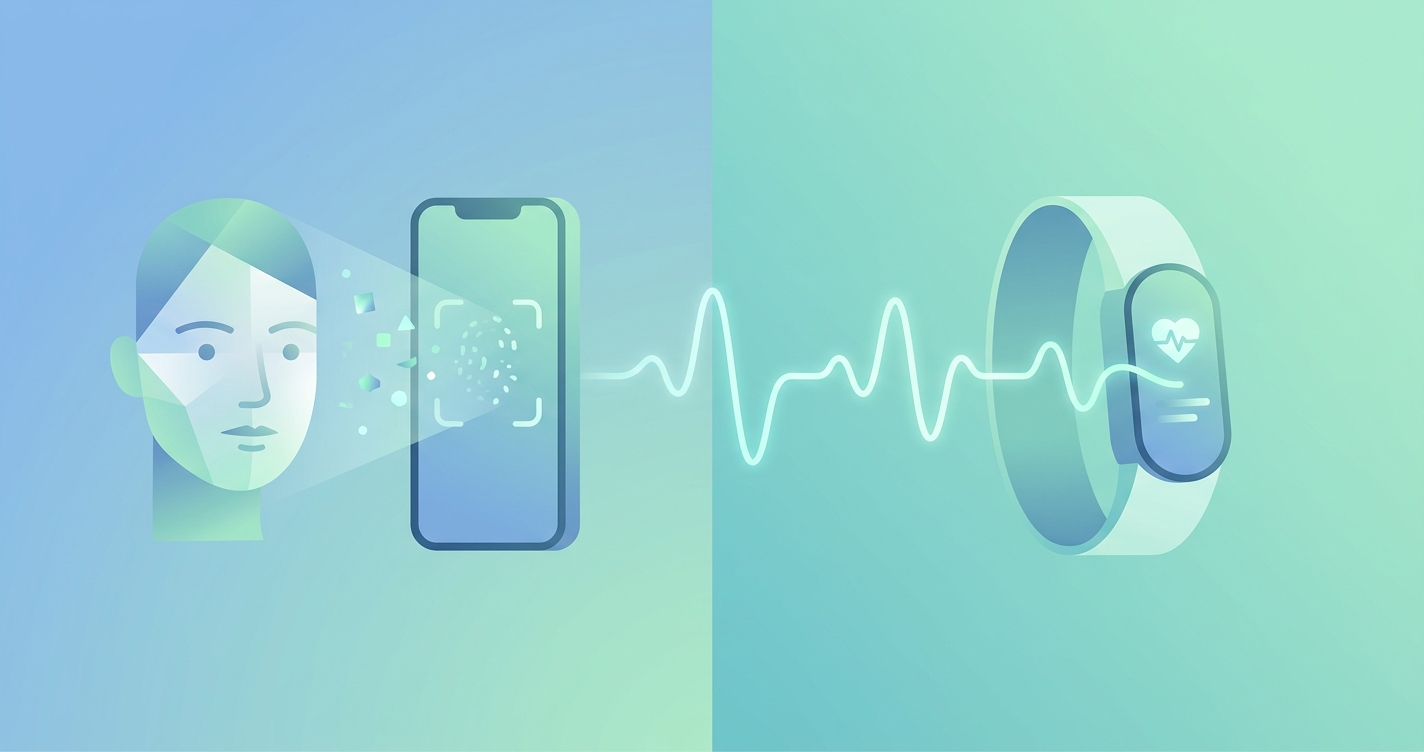
Clinical informatics teams evaluating virtual care infrastructure now face a structural decision that did not exist five years ago: how does a trustworthy vital sign actually enter a video encounter? Two technologies compete for that role. The first reads heart rate, respiratory rate, and related signals from the patient's own camera using remote photoplethysmography. The second relies on patient-owned wearables that stream physiological data into the record between visits. Understanding camera-based clinical vitals vs wearables is no longer an academic exercise for procurement committees. It shapes data governance, reimbursement strategy, equity of access, and the long-term cost of every virtual program a health system runs.
Clinician use of remote patient monitoring reached 81% of providers in 2023, a 305% increase since 2021, with the global RPM market valued at $14 billion in 2023 and projected to reach $41.7 billion by 2028 at a 20.1% annual growth rate. Source: Vivalink clinician survey and industry market estimates, 2023-2024.
Camera-based clinical vitals vs wearables: how the two models differ
The two approaches solve the same problem through opposite architectures, and the distinction matters for any informatics team mapping data flow. Camera-based capture, or contactless vitals, uses the RGB sensor already present in a patient's phone or laptop. Algorithms detect subtle color fluctuations in facial skin caused by blood volume changes, then derive pulse rate, respiratory rate, and in some implementations heart rate variability and estimated oxygen saturation. Nothing ships to the patient. The measurement happens inside the visit, at the moment a clinician needs it.
Wearable health monitoring inverts that model. The patient owns a wrist device, ring, or patch that samples physiology continuously, then synchronizes to a cloud service that ideally pushes structured data into the electronic health record. The strength is longitudinal density. The weakness is that the health system depends on a device it does not control, worn by a patient who may or may not charge it, sync it, or own one at all.
For virtual care vital signs specifically, the timing distinction is decisive. A wearable answers "what was this patient's resting heart rate last Tuesday night." A camera answers "what is this patient's heart rate right now, while I am talking to them." Most virtual encounters need the second answer, and the workflow implications cascade from there.
Remote vitals comparison: accuracy, cost, and adoption
The published evidence lets informatics teams compare the two models on the dimensions that drive procurement. The table below synthesizes peer-reviewed accuracy data alongside operational factors.
| Dimension | Camera-Based (rPPG) | Patient-Owned Wearables | | --- | --- | --- | | Heart rate accuracy (rest) | MAE 1.06 bpm vs ECG in cardiovascular patients (Feb 2026 validation) | MAE ~4.6 bpm in sinus rhythm at rest (ACC) | | Accuracy under motion / exertion | Degrades at elevated heart rates and with movement | Wrist error ~18.4%; up to 13.8 bpm difference at peak exercise | | Respiratory rate | Mean difference ~0.37 BrPM (optimal algorithm, June 2024) | Often not directly measured | | Hardware cost to system | None; uses existing patient camera | Device cost, replacement, and logistics | | Patient ownership required | No | Yes; excludes non-owners | | Data timing | Point-of-care, in-visit | Continuous, between visits | | EHR integration burden | Single in-visit data event | Continuous stream, standardization gaps | | Equity exposure | Broad reach across device types | Skews toward patients who can afford devices |
A few patterns deserve emphasis for teams weighing the trade-offs:
- Both technologies rest on photoplethysmography, so both share sensitivity to skin tone, ambient light, and motion. Neither is immune, and validation across diverse populations remains essential for both.
- Camera-based capture removes hardware logistics entirely, while wearables introduce procurement, distribution, charging, and replacement workflows that scale poorly across large panels.
- Wearables generate continuous data that camera capture cannot match, which makes them complementary rather than purely competitive for chronic disease cohorts.
- Adoption economics differ sharply: wearables require either patient purchase or system-funded distribution, while camera capture monetizes infrastructure the patient already owns.
Industry Applications
Virtual-first primary care
In high-volume virtual primary care, the binding constraint is whether a vital sign appears in every visit, not whether one patient has rich overnight data. Camera-based capture fits this need because it works for any patient who can join a video call. Wearable health monitoring covers only the subset of patients who own and consistently wear a device, which leaves documentation gaps across the broader panel.
Chronic disease management
Here the calculus shifts. Hypertension, heart failure, and arrhythmia programs benefit from the continuous data density that wearables provide, and major EHR vendors have built ingestion pathways for patient-generated data. The realistic enterprise pattern blends both: camera capture anchors the scheduled encounter, while wearables enrich the interval for enrolled, higher-acuity cohorts.
Behavioral health and triage
For stress, heart rate variability, and triage workflows, the in-visit measurement carries operational weight. A triage nurse needs a number during the call, not a retrospective trend. Camera-based capture supports that decision point without asking the patient to own equipment, which matters for acute and unscheduled contacts.
Current research and evidence
The accuracy gap at rest is narrower than many procurement teams assume, and in some controlled comparisons it favors camera capture. A clinical validation study published in February 2026, using data collected in 2024, reported that rPPG-derived pulse rate agreed with ECG at a mean absolute error of 1.061 bpm with a Pearson correlation of 0.962 in cardiovascular disease patients. A June 2024 study on off-the-shelf hardware and open-source software found heart rate mean differences of 0.59 bpm seated and respiratory rate differences of 0.37 BrPM, both within commonly accepted deviation thresholds.
Wearable performance at rest is solid but generally less tight. American College of Cardiology summaries place wrist-based PPG mean absolute differences near 4.6 bpm in sinus rhythm at rest, rising to 7.0 bpm in atrial fibrillation. Under motion the gap widens considerably. Research on PPG accuracy across anatomical sites found wrist placement error around 18.4% compared with 7.1% to 7.7% for forehead and chest, and peak-exercise differences reaching 13.8 bpm in sinus rhythm and 28.7 bpm in AF.
Both technologies share an important caveat: accuracy degrades at elevated heart rates and under poor signal conditions, and both depend on photoplethysmography that is sensitive to skin tone and lighting. The honest reading of the evidence is not that one method wins universally, but that camera capture is competitive at the point of care while wearables dominate continuous monitoring. Adoption data reinforces the dual reality. Roughly 30 million U.S. patients were projected to use RPM tools by 2024, with over 128 million active monitoring devices worldwide, yet integration challenges persist due to a lack of standardization and proprietary data formats.
The future of remote vitals comparison
The near-term trajectory points toward layered architectures rather than a single winner. Health systems will likely standardize camera-based capture as the default for scheduled and unscheduled virtual encounters, because it requires no patient hardware and produces a clean, single in-visit data event that maps cleanly to documentation and billing. Wearables will remain the instrument of choice for enrolled chronic-care cohorts where continuous data justifies the device logistics.
Three forces will shape how the comparison resolves. First, validation across diverse skin tones and real-world conditions will determine clinical trust for both modalities. Second, EHR integration standards will decide how much engineering overhead each model imposes, with continuous wearable streams demanding more governance than discrete camera events. Third, equity considerations will push systems toward technologies that reach patients regardless of device ownership, an area where camera capture has a structural advantage. Informatics teams that plan for a blended model now, with clear rules for when each modality applies, will avoid the costlier path of retrofitting governance later.
Frequently asked questions
Is camera-based vital sign capture as accurate as wearable devices? At rest, peer-reviewed data shows camera-based rPPG performing competitively and in some studies more tightly than wrist wearables, with reported heart rate mean absolute errors near 1 bpm versus ECG. Both technologies lose accuracy under motion and at elevated heart rates, and both are sensitive to skin tone and lighting, so population-level validation matters for either choice.
Do patients need to own a wearable for camera-based vitals to work? No. Camera-based capture uses the RGB camera already in the patient's phone or computer, so it works for any patient who can join a video visit. This removes the device ownership barrier that limits wearable health monitoring to patients who can afford and consistently wear a device.
When should a health system use wearables instead of camera capture? Wearables are best suited to chronic disease cohorts that benefit from continuous, between-visit data such as heart failure or arrhythmia management. Camera-based capture is better for in-visit point-of-care measurement across high-volume primary care, triage, and behavioral health encounters. Many systems deploy both in a layered model.
What is the bigger integration challenge, camera capture or wearables? Continuous wearable streams generally impose more governance and standardization overhead because of proprietary data formats and the volume of patient-generated data. Camera-based capture produces a single discrete measurement per visit that maps more directly to existing documentation and reimbursement workflows.
Circadify is building toward this layered future with camera-based clinical vitals that capture clinical-grade signals inside every virtual visit, EHR-integrated and without requiring patient wearables. Teams comparing the two approaches in depth can request a health system demo and review the side-by-side clinical workflows at circadify.com/solutions/telehealth.