
Camera Vitals vs Home Devices: Which Telehealth Wins?
A research comparison of camera vitals vs home devices across cost, equity, and accuracy to help virtual care leaders choose a vital signs strategy.
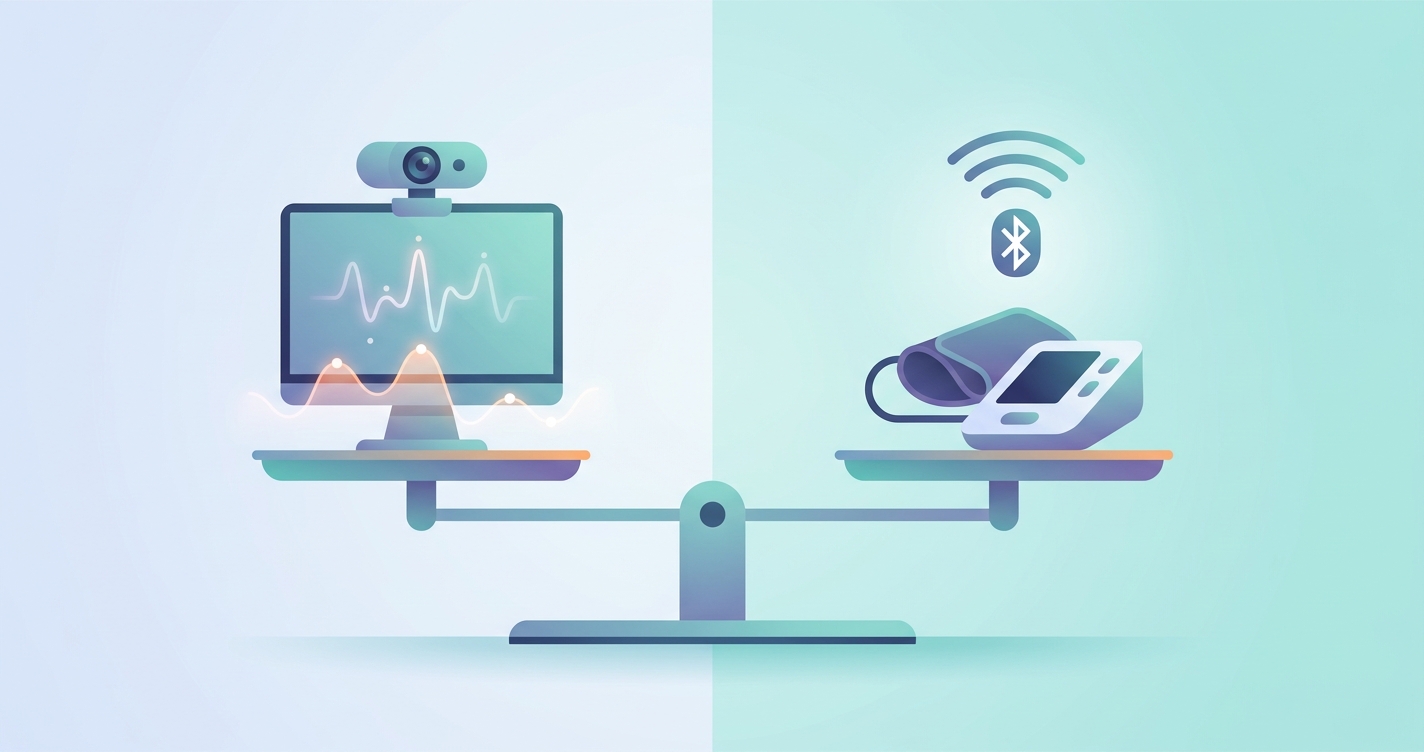
Every virtual care director eventually confronts the same architecture decision: how does a vital sign actually enter the encounter? The video call is solved. Scheduling, routing, and documentation are mature. What remains is the data gap between a patient at home and a clinician who needs a defensible heart rate, respiratory rate, and blood pressure trend. The debate over camera vitals vs home devices is where that decision now lives, and it pits two fundamentally different supply chains against each other: software running on a device the patient already owns, versus physical peripherals that must be purchased, shipped, paired, and maintained. For health system CIOs and clinical informatics teams, the choice shapes program cost, patient access, and the clinical weight a remote reading can carry.
In 2024, roughly 30 million people in the U.S. used remote patient monitoring, up from 23 million in 2020, with projections reaching 70.6 million by the end of 2025. The infrastructure question is no longer hypothetical., Health Recovery Solutions, 2024 RPM trends report
Camera vitals vs home devices: framing the real tradeoff
The core of camera vitals vs home devices is not which technology is theoretically superior in a lab. It is which model survives contact with a real patient population at scale. Camera-based capture uses remote photoplethysmography (rPPG), where a standard webcam or phone camera detects subtle color changes in facial skin caused by blood flow. Home devices, by contrast, are Bluetooth or cellular peripherals: a cuff, a pulse oximeter, a digital scale, sometimes a stethoscope, each sending readings into a monitoring platform.
The contactless vitals vs Bluetooth devices comparison breaks down along three axes that matter to a budget owner and a chief medical officer at the same time: cost structure, equity of access, and measurement accuracy. Each axis favors a different model, which is why most mature programs end up reasoning about blended deployments rather than a single winner.
| Factor | Camera Vitals (rPPG) | Home Devices (Bluetooth/cellular) | | --- | --- | --- | | Per-patient hardware cost | None beyond existing phone or laptop | $200 to $1,500 per peripheral; all-in-one kits $20,000 to $28,000 at program level | | Setup and logistics | Software only, no shipping or pairing | Device procurement, shipping, pairing, replacement | | Equity reach | Limited by camera quality, lighting, broadband | Limited by digital literacy, Wi-Fi, ability to operate hardware | | Heart rate accuracy | Reported MAE around 2 to 5 BPM in controlled studies | Established, near reference-grade | | Blood pressure accuracy | Moderate and still maturing for rPPG | Validated cuff devices are reference-grade | | Maintenance burden | Software updates only | Battery, calibration, breakage, returns | | Best fit | High-volume screening, triage, broad access | Chronic disease management, regulated BP titration |
The table makes the asymmetry obvious. Camera capture wins decisively on cost and logistics. Validated home cuffs still win on blood pressure accuracy. Equity is genuinely contested, because each model excludes a different slice of the population.
Where each model earns its place
A useful way to read the telehealth peripherals comparison is to ask what failure mode you can tolerate for a given clinical use case.
- High-volume primary care and urgent triage favor camera capture, because the marginal cost of one more patient is effectively zero and no device has to arrive in the mail before the visit.
- Hypertension titration and post-discharge cardiac monitoring still lean on validated cuffs, where a blood pressure number drives a medication change and must hold up to scrutiny.
- Behavioral health and wellness check-ins fit camera-based heart rate and heart rate variability well, since trend direction matters more than a single regulated threshold.
- Rural and low-broadband populations may actually be better served by cellular home devices that do not depend on a stable video stream or good lighting.
Industry Applications
Health system screening and triage
For a nurse triage line or a same-day virtual clinic, the operational math is brutal and clear. Shipping a peripheral introduces days of latency and a return logistics tail. Camera-based capture lets a triage nurse read a heart rate and respiratory rate inside the encounter the patient is already in. The 2024 telehealth survey context, with 79 percent of U.S. hospitals having adopted telehealth, means most systems already have the video rails; adding rPPG is a software integration rather than a supply chain.
Chronic disease programs
Chronic care reverses the calculus. A patient managing hypertension needs blood pressure readings that can defend a prescription change. Here the moderate accuracy of rPPG blood pressure, with some studies reporting overall accuracies near 61 percent for systolic and 56 percent for diastolic, is not yet sufficient as a standalone basis for titration. Validated home cuffs remain the reference, and Medicare reimbursement structures, including roughly a $19 setup fee and about $55 per month for device supply and data transmission, are built around exactly this peripheral-driven workflow.
Access and equity programs
The digital divide does not have one shape. The Agency for Clinical Innovation and equity researchers note that rural, lower-income, and low-digital-literacy patients face barriers to remote monitoring. Home devices exclude patients who cannot operate or pair hardware. Camera capture excludes patients with older cameras, poor lighting, or unstable broadband, and rPPG accuracy is known to vary with skin tone and motion. Neither model is automatically more equitable; a serious program measures exclusion in its own population rather than assuming.
Current research and evidence
The evidence base for virtual visit vitals accuracy has matured quickly. A 2025 study of a non-contact PPG-based mobile application reported heart rate mean absolute error of 2.96 BPM and SpO2 MAE of 2.10, which approaches clinical usefulness for those two signals. Clinical validation work on rPPG-enabled contactless pulse rate monitoring in cardiovascular disease patients has reinforced that resting heart rate is the strongest contactless signal.
The caveats are equally documented. Researchers have shown that rPPG accuracy for heart rate can drop sharply at elevated heart rates, and that movement, lighting, and skin tone influence results. A systematic review of non-contact vision-based vital sign monitoring, published in MDPI, concluded that heart rate and respiratory rate are well supported by current methods while blood pressure remains the hardest target. On the home device side, accuracy is rarely the open question; validated cuffs and oximeters are reference instruments, so the research focus is adherence, connectivity, and whether patients actually take and transmit readings.
The honest synthesis: for heart rate, respiratory rate, and SpO2, the accuracy gap between camera vitals vs home devices is narrowing to the point where the cost and access advantages of camera capture dominate. For blood pressure, validated peripherals retain a clear edge for any decision with regulatory or prescribing weight.
The future of camera vitals vs home devices
The market is not heading toward a single winner. The remote patient monitoring market, valued near $55.1 billion in 2023 and projected to grow at roughly 18.3 percent annually through 2032, is large enough to sustain both models in parallel. The likely equilibrium is tiered: camera-based capture as the default first layer in every virtual visit because it is free at the margin, with validated home devices reserved for conditions where a regulated number drives treatment.
Three shifts will define the next few years. First, rPPG blood pressure models will keep improving, gradually moving from wellness signal toward clinical candidate, though validation will lag the marketing. Second, EHR integration will become the real differentiator, because a reading that does not flow into the chart with provenance metadata is operationally useless regardless of how it was captured. Third, equity measurement will become a procurement requirement, forcing vendors to report performance across skin tones, lighting, and device classes rather than headline averages. Health systems that design for a blended model now, and instrument their own exclusion data, will adapt faster than those betting on one approach.
Frequently asked questions
Is camera-based vitals capture accurate enough to replace home devices entirely? For heart rate, respiratory rate, and SpO2, contactless capture is closing in on reference-grade in controlled conditions, with reported heart rate MAE around 2 to 5 BPM. For blood pressure, validated home cuffs remain more reliable, so full replacement is premature for prescribing decisions.
Which option is cheaper for a health system at scale? Camera capture has a dramatically lower marginal cost because it runs on devices patients already own, with no shipping, pairing, or replacement. Home device programs carry per-peripheral costs of $200 to $1,500 and ongoing logistics, though reimbursement structures can offset some of that for chronic care.
Does one model close equity gaps better than the other? Neither is universally more equitable. Home devices exclude patients who struggle with hardware or connectivity, while camera capture can underperform with older cameras, poor lighting, or across skin tones. The right choice depends on measured exclusion in your specific population.
How should virtual care leaders decide between them? Match the failure tolerance of each clinical use case. Use camera capture for high-volume screening and triage where speed and reach matter, and reserve validated peripherals for blood pressure titration and other decisions that need a defensible, regulated reading.
Circadify is building toward exactly this blended future, with EHR-integrated camera-based vital signs that capture clinical signals in every virtual visit without requiring patient-owned hardware. To see the full cost, equity, and accuracy breakdown and the clinical workflows behind it, explore the comparison resources and request a health system demo at circadify.com/solutions/telehealth.