How can my cardiologist truly understand my heart health from a video screen today?
How camera-based vitals close the cardiology data gap in virtual visits, giving cardiologists clinical-grade heart data over a video screen. A CIO guide.
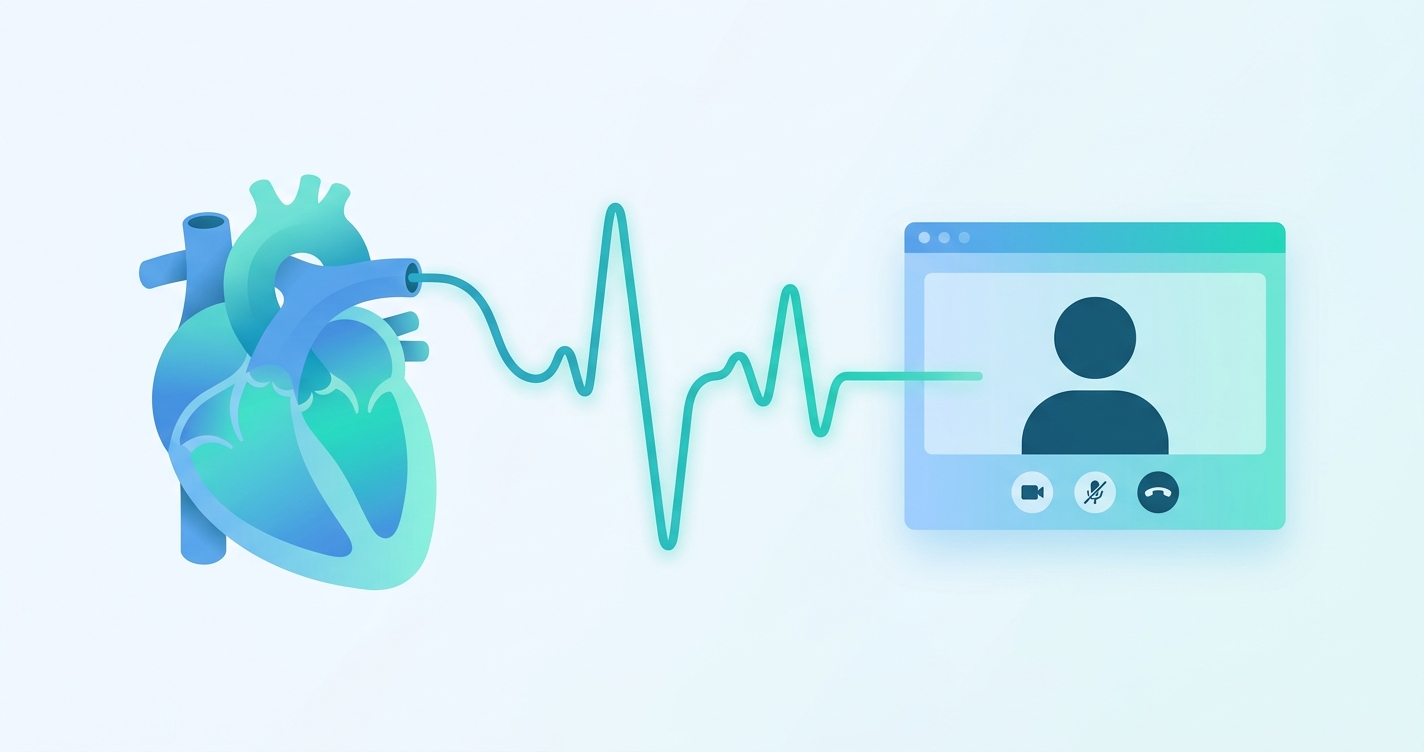
A cardiology consult has always depended on numbers the clinician can trust: a heart rate, a blood pressure, a rhythm pattern, a respiratory rate read against the patient's history. When that encounter moves to a video screen, those numbers do not automatically follow. For years, virtual cardiology meant a careful conversation wrapped around a clinical blind spot, and that blind spot has measurable consequences for both diagnosis and risk. The question of how a cardiologist can truly understand your heart health from a video screen, and the related question of how a health system can guarantee that understanding at scale, now sits at the center of specialty virtual care strategy. The answer increasingly involves capturing real cardiac signals from the camera feed itself.
A 2023 clinical validation study of contactless pulse rate monitoring in cardiovascular disease patients reported a mean absolute error of 1.061 bpm and a Pearson correlation of 0.962 against ECG, demonstrating that camera-derived cardiac data can closely track gold-standard measurement.
What cardiologist video heart health really requires
The central problem in telehealth cardiology is not the conversation. It is the data. A primary limitation of virtual cardiology consultations is the inability to directly assess vital signs, and that limitation is not cosmetic. Research on telemedicine versus office-based care of patients with cardiac symptoms found that the absence of in-visit measurement contributes to underdiagnosis and undertreatment of cardiac risk factors. One analysis observed roughly a 37 percent decline in blood pressure assessment during the early pandemic shift toward virtual encounters. For patients presenting with dyspnea, virtual visits were associated with a higher risk of 30-day heart failure hospitalization and a reduced likelihood of referral for echocardiography.
So when patients ask how their cardiologist can understand heart health from a video screen, the honest baseline answer used to be: only partially. The clinician could see, listen, and interview, but could not measure. Camera-based vital signs capture changes that baseline. Using remote photoplethysmography, or rPPG, software analyzes subtle color changes in the skin caused by blood flow to derive pulse rate, and increasingly pulse rate variability, respiratory rate, and estimated blood pressure trends, from a standard video stream. No cuff, no wearable, no peripheral device required from the patient.
For a health system CIO evaluating technology for specialty virtual clinics, the distinction that matters is between a video platform that streams a face and a video platform that extracts clinical signal from that face and routes it into the record.
| Capability | Standard video visit | Patient self-report or home device | Camera-based vitals (rPPG) in the visit | | --- | --- | --- | --- | | Heart rate captured in-visit | No | Sometimes, device dependent | Yes, contactless from video | | Pulse rate variability for autonomic signal | No | Rarely | Yes, where supported | | Respiratory rate | Visual estimate only | No | Yes | | Requires patient to own hardware | No | Yes | No | | Data flows to the EHR automatically | No | Manual entry, often skipped | Yes, integrated | | Consistency across patient population | N/A | Low, depends on access | High, every visit | | Documentation for risk coding | Weak | Inconsistent | Structured and timestamped |
The operational gap that camera-based capture closes is consistency. Self-report and home devices help patients who own and correctly use them, but they leave equity and completeness problems that a CIO has to answer for across an entire panel. A capture method built into the visit itself produces the same data type for every patient, regardless of whether they own a cuff.
Key reasons this matters for specialty virtual clinics:
- Cardiology decisions hinge on quantitative thresholds, not impressions, so missing vitals degrades the encounter more than in most specialties.
- Risk adjustment and quality reporting depend on documented measurements that self-report rarely supplies.
- A contactless method removes the access barrier that wearables and home cuffs impose on lower-income and older patients.
- Structured, timestamped data supports longitudinal trend analysis across repeated virtual follow-ups.
Industry applications for specialty virtual clinics
Heart failure follow-up and titration
Heart failure management is built on serial measurement. A mobile application study evaluating remote vital signs in heart failure patients framed the opportunity directly as remote titration, adjusting medication based on reliably captured data between in-person visits. Camera-based capture during a scheduled video follow-up gives the cardiology team a defensible heart rate and respiratory trend to act on, rather than asking a patient to interpret their own symptoms.
Hypertension and risk-factor surveillance
Given the documented decline in blood pressure assessment during virtual encounters, any in-visit signal that reestablishes measurement discipline has clinical value. Research into transdermal optical imaging has shown that app-based estimation of blood pressure and heart rate can approximate non-invasive clinical measurement in cardiac populations, pointing toward camera-based screening as a triage and surveillance layer rather than a replacement for confirmatory cuff readings.
Arrhythmia and autonomic monitoring
Pulse rate variability derived from the video stream offers a window into autonomic function. While rPPG is not a substitute for diagnostic ECG, trended variability data flags patients who warrant closer rhythm evaluation, helping the cardiologist decide who needs to come in for an echocardiogram or Holter monitor and who can continue safely in the virtual pathway.
Current research and evidence
The evidence base for contactless cardiac measurement has matured from proof-of-concept to clinical validation. The 2023 study of rPPG-enabled contactless pulse rate monitoring in cardiovascular disease patients enrolled 50 adults with confirmed CVD and compared pulse rate from 25-second facial video segments to ECG. The reported mean absolute error of 1.061 bpm and correlation of 0.962 are notable precisely because the cohort had established cardiac disease rather than being healthy volunteers. Mixed-effects regression in that work indicated minimal influence from demographic, environmental, or CVD-related factors on accuracy.
Independent work points to the same direction across settings. A prospective cohort study validated video-based vital sign monitoring in the intensive care unit, and Google Research demonstrated in 2023 a system that passively measures heart rate via smartphone camera with accuracy reported across all skin tones, meeting consumer-grade industry standards.
The literature is equally clear about limits, which a CIO should weigh honestly. Accuracy of rPPG can drop sharply at elevated heart rates, and the method remains sensitive to motion artifacts and lighting conditions. Reviews of remote heart rate measurement using photoplethysmography and deep learning emphasize the need for more robust approaches across diverse cohorts and irregular rhythms. These are engineering and deployment constraints, not disqualifiers, and they argue for clinical governance, provider training, and validation before enterprise rollout rather than against the technology.
The future of cardiologist video heart health
The trajectory is toward virtual cardiology encounters that are quantitatively comparable to a brief in-clinic intake. Three shifts are underway. First, deep learning integrated with rPPG is steadily improving signal extraction under real-world conditions, narrowing the accuracy gap at higher heart rates and in motion. Second, the expectation is moving from optional to default: as documentation, coding, and quality programs come to expect in-visit vitals, capturing them passively becomes part of standard virtual workflow rather than a premium feature. Third, integration depth will define value. Data that lands automatically in the EHR, trends across visits, and surfaces inside the cardiologist's existing view will matter more than any single measurement.
For health systems, the strategic implication is that specialty virtual care quality will increasingly be judged by data completeness. A video visit that produces a documented heart rate, respiratory rate, and variability trend for every patient is a fundamentally different clinical product than one that produces only a conversation.
Frequently asked questions
Can a cardiologist actually measure my heart rate through a video screen?
Yes, when the platform uses remote photoplethysmography. The software detects tiny color changes in your skin caused by blood flow and converts them into a pulse rate. A 2023 validation study in cardiovascular disease patients found camera-derived pulse rate closely tracked ECG, with a mean absolute error near 1 bpm. It does not replace diagnostic ECG, but it gives the clinician a real measured value during the visit.
Do I need a wearable or blood pressure cuff for the cardiologist to get this data?
No. Camera-based capture works from a standard device camera and requires no patient-owned hardware. This is a deliberate design choice for health systems, because it removes the access and equity barriers that come with expecting every patient to own and correctly use a home device.
Is camera-based heart data accurate enough to make treatment decisions?
It is accurate enough to support screening, surveillance, and trending, and validation studies show strong agreement with reference measurements at rest. Accuracy can decline at elevated heart rates and with motion or poor lighting, so health systems should treat it as a clinical input within a governed workflow, with confirmatory testing where decisions require it.
How does this data reach my cardiologist's records?
In a well-designed deployment, captured vitals flow directly into the EHR as structured, timestamped entries rather than manual notes. That integration is what lets the cardiology team trend values across repeated virtual follow-ups and use them for documentation and risk reporting.
Circadify is building toward this gap between what a virtual cardiology visit looks like and what it measures, with camera-based vital signs capture designed for EHR-integrated specialty virtual clinics and no patient wearables required. Health system teams evaluating technology for cardiology and other specialty virtual programs can review the clinical workflows and request a demonstration at circadify.com/solutions/telehealth.