How does my doctor check my vitals during a video appointment?
Exploring the methods for capturing televisit vital signs, from patient self-reporting to camera-based rPPG technology, and their impact on virtual care quality.
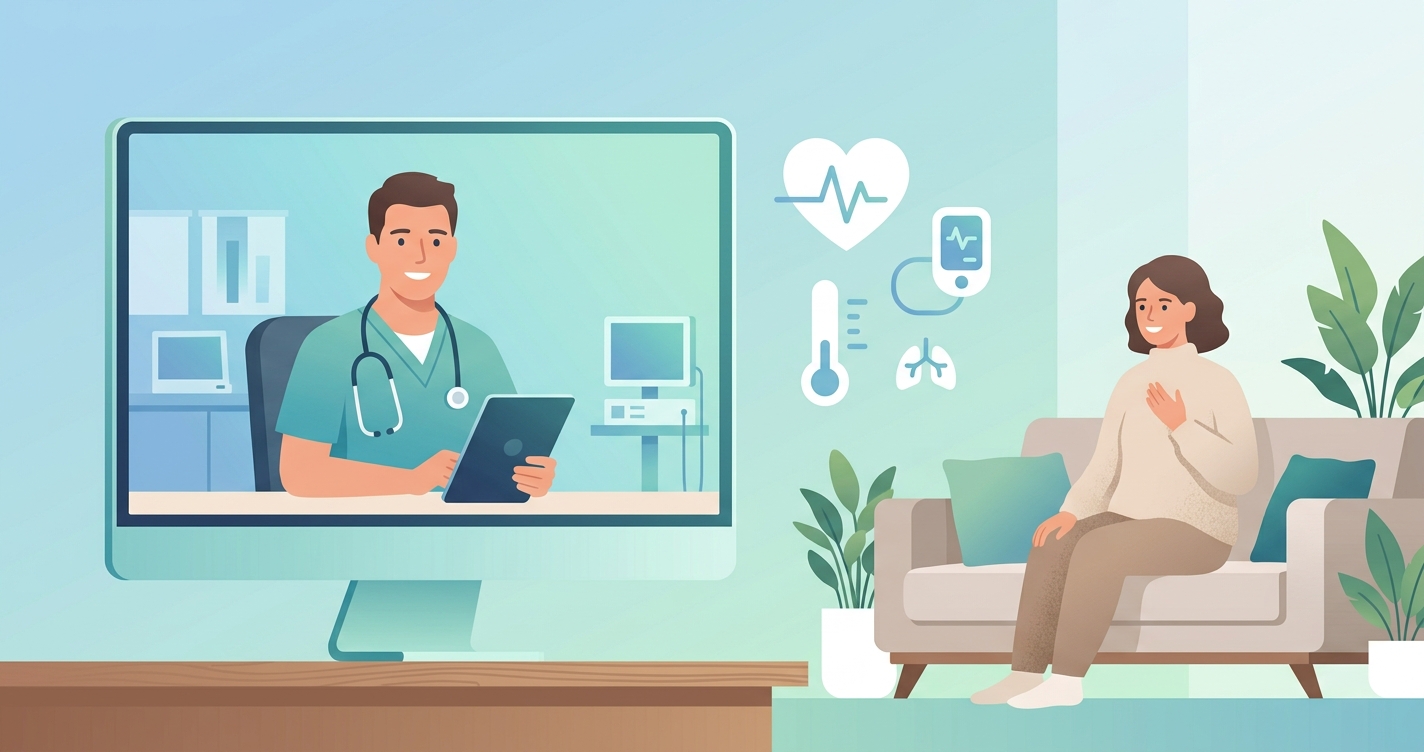
The rapid expansion of virtual care has fundamentally altered healthcare delivery, shifting from a pandemic-era necessity to a core component of health system strategy. By 2024, 79% of U.S. hospitals had formally adopted telehealth services, indicating that video appointments are a permanent and strategic part of patient care. However, as these virtual encounters become standard, a critical question arises for clinicians and health system leaders: How do we capture the essential clinical data that was once standard in every exam room? Without reliable vital signs, a virtual visit remains a conversation, not a comprehensive clinical assessment. This data gap presents a significant challenge to ensuring quality, safety, and diagnostic accuracy in a virtual setting.
"A 2023 analysis published in the American Journal of Managed Care highlighted that while telehealth use has stabilized from its 2020 peak, it remains substantially higher than pre-pandemic levels, signifying a permanent shift in care delivery models."
Methods for capturing televisit vital signs
The central challenge in remote assessment is the acquisition of accurate, timely patient data. For televisit vital signs, health systems have evaluated several methods, each with distinct implications for clinical workflow, data reliability, and patient experience. The primary approaches include patient self-reporting, the use of connected peripheral devices, and emerging contactless technologies that use the patient's own device camera. The choice of method has significant downstream effects on everything from EHR integration to clinical decision support and overall program scalability.
The initial and most straightforward method is patient self-reporting. In this model, a provider asks the patient to measure their own vital signs, often using a consumer-grade device like a blood pressure cuff or thermometer they happen to own. While this approach requires no new technology investment from the health system, its clinical utility is limited. Studies have consistently shown that self-reported vitals are prone to inaccuracies due to a range of factors, including improper technique, device-specific variance, and a phenomenon known as "digit preference," where patients round their measurements to the nearest whole number. A study by researchers at the University of California, San Diego (2021) found significant discrepancies between patient-reported measurements and those taken in a clinical setting, raising concerns about the reliability of this data for diagnostic or treatment decisions.
A more structured approach involves the use of connected, or "paired," peripheral devices. This model, often associated with remote patient monitoring (RPM) programs, requires patients to use specific, health-system-provisioned devices like Bluetooth-enabled blood pressure cuffs, pulse oximeters, and scales. The data is automatically transmitted to the provider or care team, offering a significant improvement in accuracy and reliability over self-reporting. However, this method introduces logistical and financial challenges for the health system, including device procurement, inventory management, shipping, patient training, and technical support. Scaling this model enterprise-wide for synchronous televisits is often cost-prohibitive and operationally complex.
The third and most recent development is the use of contactless, camera-based measurement technology. This method utilizes remote photoplethysmography (rPPG), a software-based technique that analyzes subtle changes in light reflected from the skin to measure blood flow. By using the patient's existing smartphone or laptop camera, rPPG can extract vital signs like heart rate, heart rate variability, respiratory rate, and even blood pressure and oxygen saturation. This approach eliminates the need for patient-owned devices or health system-provisioned hardware, making vital sign capture accessible for any video visit. It represents a highly scalable model for integrating foundational clinical data into the standard televisit workflow.
| Method | Description | Advantages | Disadvantages | | :--- | :--- | :--- | :--- | | Patient Self-Reporting | Patients use their own consumer devices to measure and verbally report vitals. | No technology cost; easy to implement for a single visit. | Highly prone to error; inconsistent device quality; lacks data traceability. | | Connected Peripherals | Patients use health-system-provided, Bluetooth-enabled devices (cuffs, oximeters). | High accuracy and reliability; data is structured and automated. | High cost; logistical complexity (shipping, support); patient setup required. | | Camera-Based (rPPG) | Software uses the patient's device camera to measure vitals contactlessly. | Highly scalable; no patient hardware needed; integrates into any video visit. | Accuracy can be affected by motion, poor lighting, and certain skin tones; requires modern device. |
Industry Applications
For health system CIOs and virtual care directors, the method of capturing televisit vital signs is a strategic decision with broad implications. The goal is to create a seamless flow of reliable clinical data into the EHR, where it can inform decision-making without disrupting clinical workflows or creating undue burden.
EHR Integration
A primary challenge is ensuring that data captured during a virtual visit is recorded as structured, usable data in the EHR, not just a note in a free-text field. Camera-based and connected device solutions are designed to feed data directly into the patient's chart via standard APIs, making the measurements actionable for alerts, trending, and quality reporting.
Clinical workflow design
Technology must adapt to the clinical workflow, not the other way around. An effective solution for vital signs capture must be initiated with a simple click from within the telehealth platform. The process should add no more than 60-90 seconds to the visit, a critical factor for provider adoption and clinic efficiency.
Data governance and security
Capturing vital signs via a patient's device introduces new data governance considerations. CIOs must ensure that any solution is compliant with HIPAA, with clear policies on where the data is processed (e.g., on-device vs. in the cloud) and how it is transmitted to the EHR.
Current research and evidence
The validation of camera-based vital sign measurement is a growing area of clinical research. A 2023 study published in medRxiv by Goyal et al. evaluated a smartphone-based rPPG application and reported high accuracy for heart rate (97.3%) and systolic blood pressure (93.9%) when compared to clinical-grade devices under controlled conditions. This and other studies demonstrate that rPPG can achieve clinical-grade accuracy for several key parameters.
However, researchers are also clear about the current limitations. The accuracy of these algorithms is sensitive to factors such as:
- Motion: The patient must remain relatively still during the measurement.
- Lighting: Poor or inconsistent lighting can interfere with the signal.
- Skin Tone: Algorithms must be trained on diverse datasets to ensure equitable performance across all skin tones.
Ongoing research, including a clinical trial registered by the University of South Australia (NCT05292645), continues to assess the accuracy of rPPG software for a range of vital signs in home-like environments, refining the algorithms to account for these real-world variables.
The future of televisit vital signs
As virtual care matures, the focus is shifting from access to clinical quality. The ability to capture foundational vital signs in every televisit is a critical step in this evolution. Contactless technologies like rPPG are positioned to become a standard feature within telehealth platforms, making the collection of objective patient data as routine as it is during an in-person visit. For health systems, this capability will unlock higher-quality virtual encounters, improve remote triage and monitoring, and provide the data needed to meet future quality metrics and reimbursement requirements tied to virtual care. The integration of this technology is not just about enhancing a single visit; it is about building a more robust and clinically credible virtual care infrastructure for the future.
Frequently asked questions
Q: Is rPPG technology as accurate as a traditional blood pressure cuff? A: Current research shows that rPPG can be highly accurate for heart rate and respiratory rate. For blood pressure, accuracy is improving but can be more variable than a traditional cuff. Many systems use rPPG for screening and trending, with a cuff used for confirmation if readings are outside of normal parameters.
Q: How is patient data protected when using a camera-based system? A: Leading camera-based solutions process video frames on the device itself or in a secure, ephemeral cloud environment. The video stream is not typically stored. The resulting vital sign data is encrypted and sent directly to the EHR, adhering to the same HIPAA standards as any other clinical data.
Q: What is the a "televisit vital signs" workflow like for the provider and patient? A: Typically, the provider or a nurse initiates the capture from their telehealth interface. The patient sees a prompt on their screen asking for consent and providing instructions, such as looking at the camera and remaining still for 30-60 seconds. The results are then displayed to the provider and sent to the EHR.
Q: Does this technology work on any smartphone or computer? A: Most modern smartphones, tablets, and laptops with a standard front-facing camera are compatible with rPPG technology. The processing requirements are not intensive, making it accessible to a wide range of patients without needing specialized equipment.
As health systems continue to scale their virtual care programs, the ability to capture clinical-grade data is the next frontier. Circadify is focused on solving this challenge by enabling the capture of vital signs through the devices patients already own. To learn more about integrating this capability into your telehealth platform and clinical workflows, explore our solutions at circadify.com/solutions/telehealth.