How Nursing Triage Uses Camera-Based Vitals in Virtual Visits
How nursing triage camera vitals virtual workflows add objective data to remote assessments, escalation, and documentation in virtual visits.
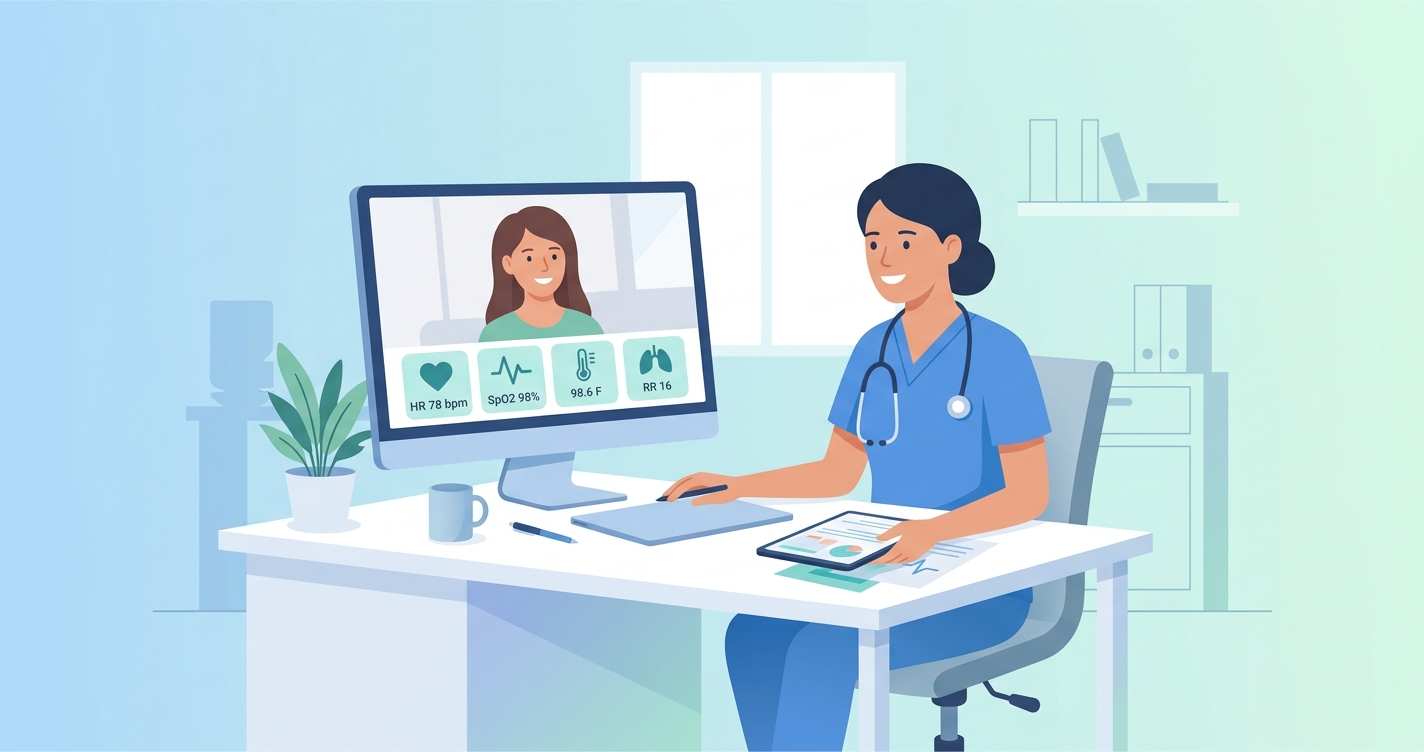
Nursing triage camera vitals virtual workflows are starting to answer a problem that telehealth teams have been living with for years: the nurse can hear the symptoms, see the patient, and document the complaint, but the encounter still lacks the fast objective data that anchors an in-person triage decision. In virtual visits, that gap matters. A nurse deciding whether to reassure, escalate, or redirect care is often working without the heart rate, oxygen trend, or physiologic context that would normally be taken in the first few minutes of intake.
“A standard approach to triage can minimize patient safety risks and support appropriate telehealth use,” wrote Mahrokh M. Mirzakhani, Jennifer S. W. Graber, and Susan D. Ruppert in the Journal of the American Association of Nurse Practitioners (2022).
Why camera-based vitals matter in nursing triage virtual workflows
Nursing triage is really a sorting function under uncertainty. The nurse has to determine urgency, choose the right level of care, and document why that decision made sense. In a clinic, vitals narrow the uncertainty quickly. In a virtual visit, many programs still rely on symptom descriptions alone unless the patient happens to own a pulse oximeter or home cuff.
Camera-based vitals change the shape of that first assessment. Instead of asking whether the patient has a device nearby, the workflow can capture a short measurement from the camera already being used for the visit. That does not replace nursing judgment. It gives the nurse another layer of evidence.
A useful way to think about the role of camera-based measurement in triage is not as a diagnostic endpoint, but as an intake signal. It can help a nurse decide whether a patient appears stable enough for standard virtual follow-up, whether a provider should join immediately, or whether the case needs in-person escalation.
| Triage question | Traditional virtual visit | Virtual visit with camera-based vitals | |---|---|---| | Is there objective physiologic data at intake? | Often no | Often yes, if capture conditions are adequate | | Does the nurse need patient-owned hardware? | Usually yes | No separate device required | | Can abnormal findings be documented before provider handoff? | Inconsistent | More structured | | Is escalation based only on symptoms? | Often | Symptoms plus vital-sign context | | Can data flow into longitudinal workflows? | Limited | Better fit for telehealth documentation and review |
The operational appeal is obvious for health systems. Triage lines, urgent virtual visits, post-discharge checks, and nurse-first telehealth models all depend on moving patients to the right next step without wasting provider time or sending too many people to the emergency department out of caution alone.
Where the research stands on camera-based vitals
The evidence base around remote photoplethysmography, or rPPG, is maturing fast enough that clinical operations teams can no longer dismiss it as a novelty. In a 2025 Sensors review, Ahmad Hassanpour and Bian Yang of the Norwegian University of Science and Technology described contactless vital-sign monitoring as a field moving beyond single-signal demos toward multimodal clinical systems. Their review tracked vision-based, radar-based, and hybrid approaches aimed at heart rate, respiratory rate, blood pressure, and oxygen-related measures.
A 2024 Frontiers in Digital Health review by Alora Brown, Joeri Tulkens, M. Maxime Mattelin, T. Tanguy Sanglet, and B. Brecht Dhuyvetters, all affiliated with IntelliProve in Ghent, argued that rPPG is already well established for outputs such as heart rate, respiratory rate, and heart rate variability, while higher-level metrics are still evolving. That distinction matters for nursing leaders. It suggests a practical deployment path: use camera-based vitals first where triage teams benefit from directional physiologic context and trend visibility, not from exaggerated promises.
At the same time, the literature is honest about limitations. In npj Digital Medicine (2025), Bhargav Acharya, William Saakyan, Barbara Hammer, and Hanna Drimalla tested eight rPPG algorithms on the CHILL dataset and found that five of the eight showed statistically significant performance decline at elevated heart rates. Low light mattered less than high pulse states. For triage teams, that is a useful operational lesson: workflow design matters as much as the model. If a patient is moving, distressed, or joining from a poor environment, the nurse still needs a fallback path.
- The best use case is structured intake, not blind automation
- Capture quality depends on lighting, framing, and motion
- Escalation rules still need nursing review
- Repeat measurement and provider confirmation remain important for concerning findings
How nursing triage teams actually use camera-based vitals
The most realistic virtual workflow starts before the nurse even asks the first assessment question. A pre-visit message can tell the patient to sit still, face the camera, and avoid heavy backlighting. That small setup step makes a big difference because triage is time-sensitive and the measurement window is short.
Intake before provider handoff
In nurse-first virtual care models, camera-based vitals fit naturally into intake. The nurse reviews the chief complaint, medication changes, and risk flags while the measurement runs in the background. By the time the provider joins, the chart can already include an intake snapshot rather than a blank vitals section.
This matters most in symptom-driven visits where the provider needs to know immediately whether the patient looks stable or needs a different care setting. A virtual complaint of dizziness, shortness of breath, or palpitations lands differently when the nurse can add objective context to the handoff.
Video triage and same-day routing
Triage nurses are often deciding among three paths: manage within the virtual visit, escalate to same-day in-person evaluation, or send the patient to emergency care. Camera-based vitals do not make that decision by themselves, but they can sharpen the thresholds around it.
Mirzakhani, Graber, and Ruppert's 2022 telehealth triage paper focused on the need for a consistent front-end triage protocol so remote care does not underestimate acuity. Camera-based capture fits that recommendation because it gives the protocol more usable inputs. Instead of documenting “patient reports feeling breathless,” the nurse can document symptoms plus measured physiologic context and then follow the escalation playbook.
Home-based follow-up and deterioration monitoring
There is also a broader monitoring use case around nurse-led follow-up. In a 2024 JMIR Medical Informatics pilot, Cheng-Fu Lin, Pei-Jung Chang, Hui-Min Chang, Ching-Tsung Chen, Pi-Shan Hsu, Chieh-Liang Wu, and Shih-Yi Lin evaluated a telemonitoring system using electronic National Early Warning Scores for patients receiving medical home care in central Taiwan. The study enrolled 28 participants and framed remote vital-sign surveillance as a way to catch deterioration earlier in home-based care.
That study did not focus on camera-only triage, but the operational logic carries over. Once vital-sign data becomes part of virtual nursing workflows, escalation can be more systematic and less dependent on narrative description alone.
Industry applications for nurse triage programs
Urgent virtual care
Same-day virtual care programs often struggle with over-escalation because nurses do not want to miss a deteriorating patient. Camera-based vitals can help separate the patient who needs immediate in-person evaluation from the patient who can stay in the telehealth lane with close follow-up.
Post-discharge nursing calls
Discharge teams already use scripted calls to look for worsening symptoms. Adding a short camera-based vitals capture step can make those calls more clinically useful, especially when the patient was discharged without home equipment.
Specialty triage
Pulmonology, cardiology, and oncology navigation teams each have symptom clusters where remote physiologic context helps. The value is not identical across specialties, but the workflow principle is the same: give the nurse more than a subjective symptom report.
After-hours triage
Overnight and weekend triage programs need fast, repeatable workflows. Camera-based measurement is attractive here because it uses the same consumer device the patient already has in hand, rather than relying on shipped kits or pairing steps that tend to fail at inconvenient times.
Current research and evidence
Three threads show up repeatedly in the literature and in health-system telehealth guidance.
First, remote triage needs standardization. The HHS tele-triage guidance treats remote assessment as a distinct operational model, not just a video version of front-desk scheduling. That supports tighter protocols, clearer escalation rules, and more explicit documentation.
Second, the research community increasingly treats contactless measurement as a workflow problem, not just a sensor problem. Brown and colleagues in 2024, and Hassanpour and Yang in 2025, both point toward broader system design questions: when the signal is captured, how quality is checked, and how outputs are interpreted in context.
Third, reliability varies by condition. Acharya and colleagues showed why virtual nursing teams should be careful about edge cases such as elevated heart rates and difficult capture conditions. A practical triage workflow should always include retry logic, alternate intake questions, and a clear path to device-based or in-person confirmation.
The future of nursing triage camera vitals virtual care
The next phase is not likely to be a single breakthrough study. It will be workflow consolidation. Health systems will keep asking the same operational questions: Can nurses collect objective data before provider handoff? Can that data enter the record cleanly? Can the triage protocol explain what happens when the measurement is missing, borderline, or abnormal?
That is where camera-based vitals have a strong fit. They align with nurse-led virtual care because they reduce hardware friction, shorten the gap between symptom report and objective intake, and make remote escalation more structured. The programs that benefit most will probably be the ones that treat camera-based vitals as part of triage design, staff training, and documentation governance rather than as a stand-alone feature.
If your team is mapping those workflows now, it may help to compare this model with our analysis of clinical workflows for camera-based vitals in televisits and how health systems improve virtual visit quality with real-time vitals.
Frequently Asked Questions
What role do camera-based vitals play in nursing triage?
They add objective physiologic context to remote intake. In most programs, they support nurse assessment and routing decisions rather than replacing clinical judgment.
Are camera-based vitals enough for every virtual triage decision?
No. They are most useful as structured intake data. If capture quality is poor, symptoms are concerning, or readings appear abnormal, the workflow still needs repeat measurement, alternate verification, or in-person escalation.
Why are camera-based vitals attractive for nurse-first telehealth models?
Because they reduce dependence on patient-owned hardware. That matters for same-day telehealth, after-hours triage, and post-discharge follow-up where extra setup steps can slow care or lower completion rates.
What should health systems evaluate before rollout?
Start with nursing workflow design: where measurement happens, what quality checks are visible to staff, how abnormal values trigger escalation, and how the result enters the EHR or telehealth documentation flow.
Nurse triage teams are under pressure to make remote decisions that are fast, defensible, and clinically grounded. Circadify is building for that exact operational gap by helping health systems add camera-based vital-sign capture to virtual care workflows. If you are evaluating how this could fit into provider handoffs, escalation logic, or EHR documentation, see the telehealth workflow overview at circadify.com/solutions/telehealth.