
How Virtual Care Programs Measure Clinical ROI of Vitals Capture
How health systems measure virtual care clinical ROI from vitals capture across documentation, follow-up rates, throughput, and provider confidence.
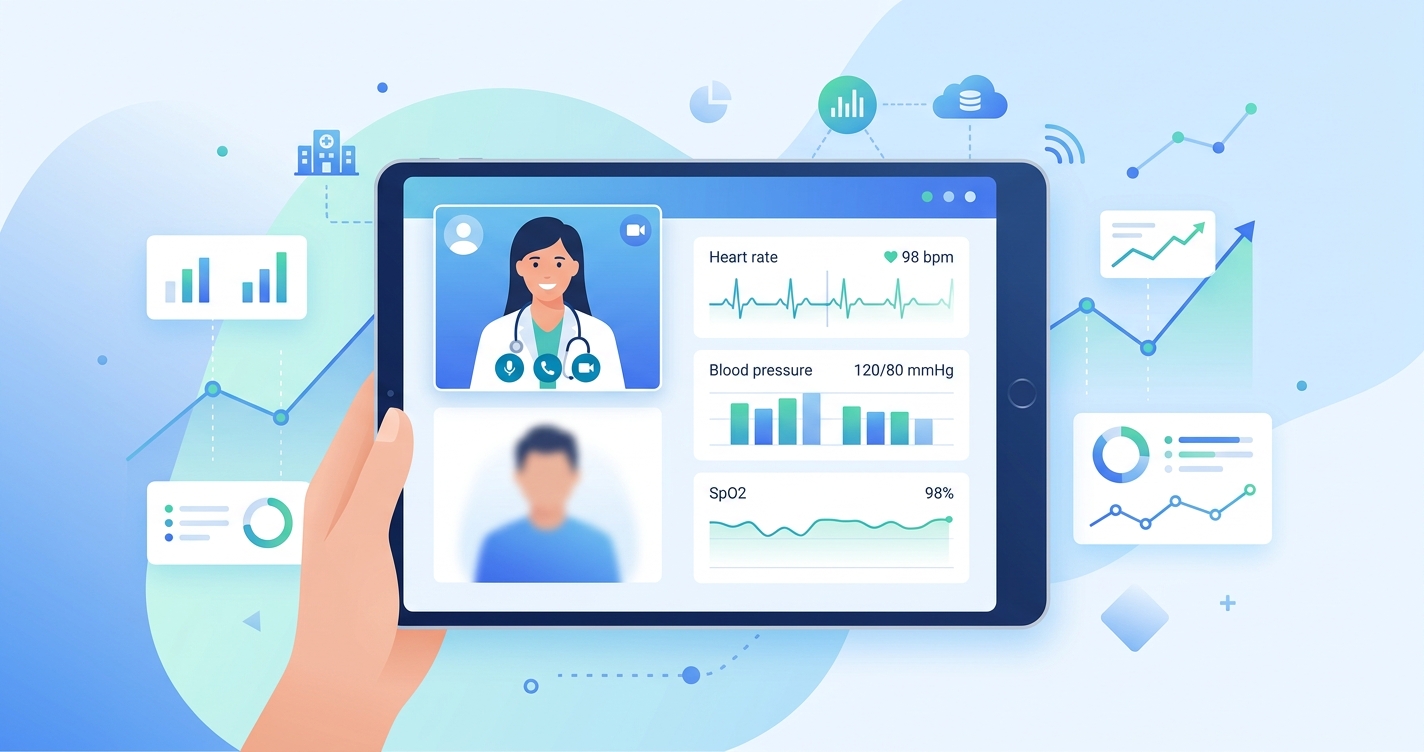
Virtual care clinical ROI vitals capture is not a finance-only question. Health systems usually discover that the return shows up first in clinical operations: more complete documentation, fewer avoidable follow-ups, better provider confidence during remote assessment, and a stronger case that a virtual visit can carry real clinical weight instead of functioning as a triage conversation.
"Approximately 70 percent of health system executives anticipate the highest impact from investments in virtual health and digital front doors," McKinsey reported in 2024. The hard part is deciding which metrics prove that impact inside an actual care program.
Virtual care clinical ROI vitals capture starts with the right denominator
A lot of telehealth ROI work goes sideways because teams only count software cost against visit volume. That misses the clinical question. If vitals capture is added to televisits, the program should measure whether remote encounters become more usable for clinical decision-making.
For most health systems, the cleanest ROI framework has four layers:
- documentation ROI: are more visits closing with structured vitals in the chart?
- workflow ROI: do clinicians need fewer second-touch encounters to finish the assessment?
- quality ROI: are remote encounters supporting quality measures instead of falling out of them?
- capacity ROI: can the system safely keep more care in the virtual channel?
That is a more useful model than asking whether camera-based vitals replaced an in-person visit in every case. Sometimes they will. Sometimes they simply keep a virtual encounter from turning into an unnecessary administrative loop.
The metrics health systems usually track
The first job is to separate leading indicators from lagging ones. Leading indicators tell the team whether vitals capture is being used. Lagging indicators show whether that usage changed operations or quality.
| ROI dimension | What to measure | Why it matters | Typical review cadence | |---|---|---|---| | Documentation completeness | Percent of televisits with structured vitals recorded | Shows whether the workflow is actually producing clinical data | Weekly | | Provider confidence | Post-visit survey score or adoption survey | Tracks whether clinicians trust remote assessment more | Monthly | | Follow-up utilization | Percent of visits converted to in-person follow-up within 7-14 days | Captures whether uncertainty is still driving rework | Monthly | | Quality performance | Inclusion and performance on measures tied to vital signs | Shows whether virtual care supports value-based programs | Quarterly | | Access and throughput | Visit completion rates, no-shows, scheduling capacity | Connects clinical quality with operational value | Monthly |
A 2022 Annals of Family Medicine study on blood pressure documentation during telehealth visits found that documentation rates dropped sharply when hypertension care moved into telehealth workflows. That matters because missing vitals do not just create sparse charts; they also weaken quality measurement and make it harder to compare virtual and in-person care fairly.
The same point showed up again in a retrospective cohort study on the controlling-high-blood-pressure quality measure during the pandemic. Researchers reported that telemedicine use looked worse on blood pressure control largely because blood pressure simply was not recorded as often during telemedicine visits. When readings were available, the care model itself was not the main problem.
Why documentation completeness is usually the first ROI win
Clinical informatics teams tend to see documentation lift before they see hard financial lift. That is normal.
When vitals are captured during a virtual visit, three things happen quickly:
- the note becomes more defensible because it includes objective physiologic data
- the encounter is easier to code, audit, and review for quality work
- the provider spends less time improvising around missing inputs
This is one of the clearest reasons many systems treat vitals capture as infrastructure rather than a feature. If the chart is consistently missing heart rate, respiratory rate, oxygen saturation, or other relevant measures, every downstream workflow inherits that gap.
For teams building a business case, a practical formula is simple: compare pre-launch and post-launch rates for structured vital-sign documentation, then map that change to quality abstraction effort, chart review burden, and measure eligibility.
Follow-up avoidance is where ROI becomes visible to operations leaders
A missing vital sign often does not end the visit. It creates a second step.
The patient gets asked to submit a home reading later. A nurse calls back. An in-person follow-up is booked because the clinician is not comfortable closing the loop remotely. None of those steps look dramatic on their own, but at health-system scale they add up.
That is why many virtual care directors track a "clinical rework rate": the share of televisits that generate an avoidable second-touch interaction because the first encounter lacked objective data.
Epic Research reported in 2024 that patients starting new blood pressure treatment had similar outcomes whether follow-up happened through telehealth or in-person care, as long as the care pathway still produced the needed monitoring information. That is the real operational point. Telehealth works better when the measurement layer is strong enough to support treatment decisions.
A reasonable ROI analysis compares:
- 7-day and 14-day in-person follow-up rates before and after vitals capture
- nurse callback volume tied to missing home measurements
- medication-change visits completed virtually versus deferred to office visits
- average time from televisit to clinical closure
Virtual visit quality measures also belong in the ROI model
ROI discussions get too narrow when they ignore value-based care.
Antoinette M. Schoenthaler, Safiya Richardson, and Devin Mann argued in a 2024 JAMA Network Open viewpoint that remote blood pressure monitoring succeeds or fails in the details of workflow, measurement reliability, and integration. That logic applies to virtual visit vitals more broadly. If the measurement process is inconsistent, the health system loses quality signal. If it is reliable and embedded, remote care becomes easier to count, trend, and defend.
For health systems in MIPS, ACO, or other risk-bearing models, vitals capture can affect ROI through:
- stronger measure denominator and numerator performance
- better chronic disease surveillance between office visits
- fewer gaps in hypertension and cardiometabolic management programs
- more usable data for population-health outreach
These are not soft benefits. They influence bonus pools, care-management targeting, and leadership confidence in scaling virtual service lines.
Capacity gains matter too, but they should be measured honestly
There is always a temptation to promise that vitals capture will eliminate huge numbers of in-person visits. Usually that is too neat.
The more credible argument is that better remote assessment helps health systems reserve in-person slots for patients who truly need escalation. That can improve panel access even if only a modest share of visits shift permanently.
A 2024 systematic review and meta-analysis of telehealth versus in-person no-show rates found a moderate reduction in non-attendance for telehealth models, with an estimated odds ratio of 0.61. That is useful context for ROI planning. If telehealth already improves attendance, adding vitals can increase the clinical value of those completed encounters rather than treating them as lighter-touch substitutes.
McKinsey's 2024 survey adds the board-level context: 75% of health system executives said current digital and AI investments were still insufficient, and the firm estimated that digital transformation could unlock $200 billion to $360 billion in annual net savings across US healthcare systems. Virtual care leaders do not need to claim that vitals capture delivers all of that. They just need to show that it strengthens one of the channels executives already expect to matter.
Industry applications for clinical ROI measurement
Primary care and hypertension management
This is usually the cleanest place to start because blood-pressure-related documentation and follow-up behavior are already tracked closely. ROI can be measured through documented vitals rates, avoided office callbacks, and quality measure stability.
Specialty follow-up clinics
Cardiology, pulmonology, and post-discharge programs often care less about raw visit volume and more about whether a remote follow-up can be clinically complete enough to avoid bringing the patient back unnecessarily.
Enterprise virtual care programs
For system-level leaders, the most useful scorecard usually combines adoption, chart completeness, escalation rates, and patient access. A finance team will ask about margin eventually, but operations leaders usually decide first whether the workflow is credible.
Current research and evidence
The literature does not give health systems a single universal ROI number, but it does give a usable measurement logic.
- The Annals of Family Medicine study on blood pressure documentation during telehealth visits showed that missing vital-sign capture can distort hypertension management workflows and downstream quality reporting.
- The retrospective cohort study on the Controlling High Blood Pressure measure found that lower recording rates, not telemedicine alone, drove weaker apparent performance during the pandemic period.
- Schoenthaler, Richardson, and Mann wrote in JAMA Network Open in 2024 that remote monitoring programs depend on details like workflow design and measurement reliability.
- The 2024 meta-analysis on no-show rates found telehealth models reduced the odds of non-attendance versus in-person care.
- McKinsey's 2024 health system survey showed executives still see virtual health and digital front doors as among the highest-impact digital investment areas.
Taken together, that evidence supports a pretty grounded conclusion: the ROI of vitals capture is best measured by how much it reduces uncertainty inside the virtual workflow.
The future of virtual care ROI measurement
The next phase will be less about proving that a camera can collect vitals and more about proving which service lines benefit most when those readings are integrated into routine care.
Expect mature programs to move beyond simple adoption dashboards and toward service-line models that connect vitals capture to:
- avoidable in-person conversion rates
- care-team labor savings
- quality measure protection
- patient access gains by specialty
That is also where solutions like Circadify fit. The value is not just that virtual visits can include an added data layer. The value is that health systems can make remote encounters more clinically complete, then measure whether that completeness changes documentation, workflow, and capacity.
Frequently asked questions
What is the best way to measure virtual care clinical ROI vitals capture?
Start with four metrics: structured vitals documentation rate, avoidable in-person follow-up rate, quality-measure performance, and provider confidence. That mix captures both clinical and operational return.
Is financial ROI enough for a telehealth vitals program?
No. A narrow finance model misses the fact that the earliest gains often show up in documentation quality, reduced rework, and better remote decision-making.
Which departments usually show ROI first?
Primary care, hypertension management, cardiology, and pulmonology often show value early because clinicians in those settings rely heavily on objective vital-sign data during follow-up care.
How should health systems compare pre-launch and post-launch performance?
Use a matched baseline period and track the same visit types over time. Most teams review documentation, second-touch follow-ups, and quality metrics monthly, then report broader ROI quarterly.
Related reading on this site: Adding Vital Signs to Your Health System's Virtual Care Program, How Health Systems Improve Virtual Visit Quality With Real-Time Vitals, and Clinical Workflows for Camera-Based Vitals in Televisits.