Signs Your Telehealth Program Needs Vitals Capture Now
Warning signs that your virtual care program lacks clinical depth without vitals capture, plus how to assess telehealth maturity and close quality gaps.
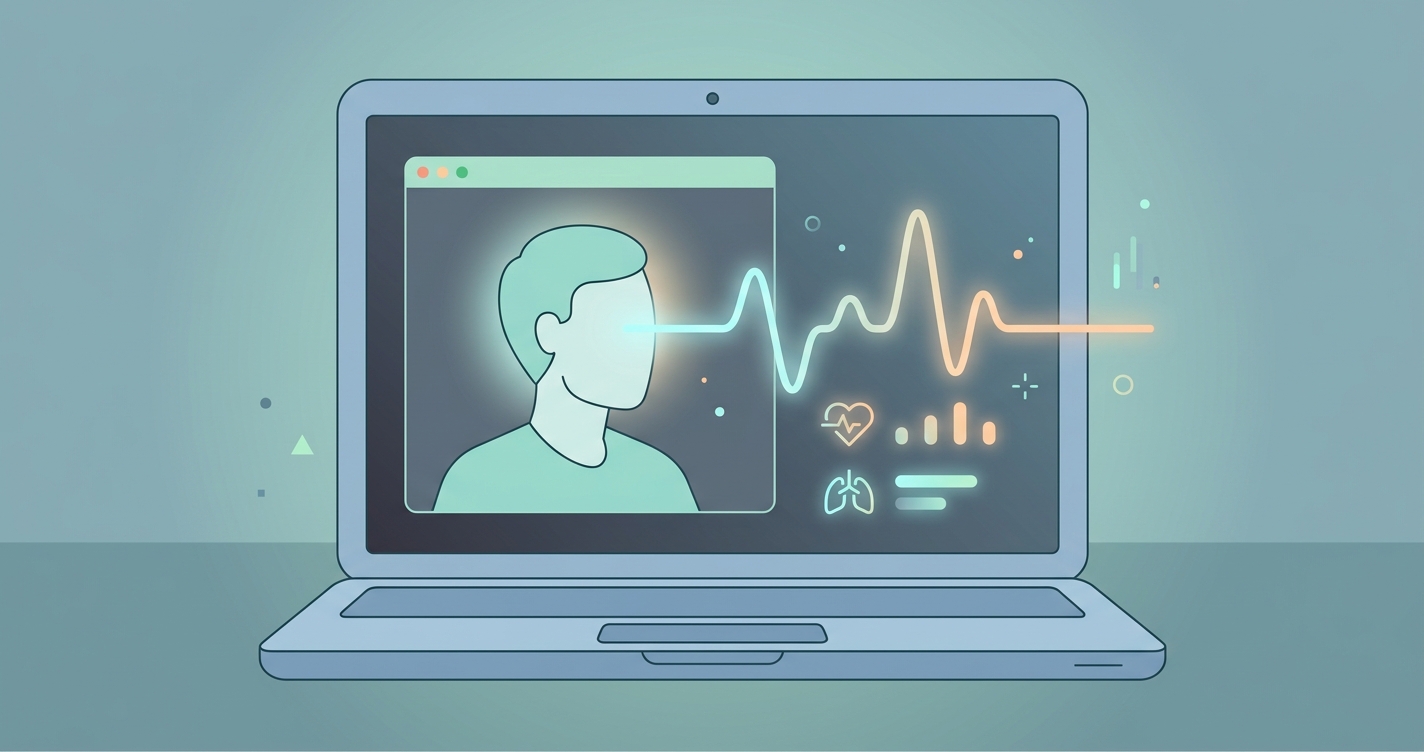
Most health systems crossed the connectivity finish line years ago. The video call works, scheduling is automated, and providers no longer fumble with cameras. Yet a growing number of virtual care directors are discovering that volume and stability are not the same as clinical maturity. The clearest signal that your telehealth program needs vitals capture is not a technology failure at all. It is the quiet accumulation of encounters that produce a documented note but no objective physiological data. When a clinician finishes a video visit and the chart contains a subjective history without a single measured value, the program has hit a clinical ceiling that better video infrastructure cannot raise.
A 2024 review of patient-collected vital signs found that values obtained through manual, unsupervised home methods are not uniformly accurate, which directly affects the reliability of telehealth triage and management algorithms that depend on them.
Why a telehealth program needs vitals capture to mature
Telehealth maturity is usually framed around access metrics: visit volume, no-show rates, patient satisfaction scores. Those numbers describe reach, not depth. The maturity signal that procurement teams and clinical informatics leaders increasingly watch is whether the encounter generates structured clinical data that flows into the EHR and supports a defensible decision. A program can scale to hundreds of thousands of visits and still operate with a structural blind spot if none of those visits reliably produce a blood pressure, heart rate, respiratory rate, or oxygen saturation reading.
Researchers studying the virtual encounter have documented this gap directly. In a qualitative hermeneutic study published in JMIR (Wong and colleagues, 2024), providers described the difficulty of fully assessing a patient's physical state remotely, noting that the loss of objective measurement changes the texture of clinical reasoning. The conversation transmits cleanly. The vitals do not. That asymmetry is the core of virtual care quality gaps, and it is the reason missing vitals in video visits has moved from an accepted limitation to an active procurement question.
The warning signs tend to cluster. A program likely needs vitals capture when several of the following are true at once:
- Clinicians routinely convert video visits to in-person follow-ups solely to obtain a blood pressure or a basic vital set.
- Chronic disease cohorts such as hypertension and heart failure are managed virtually but charted without recent objective readings.
- Triage nurses make disposition decisions on symptom description alone, with no physiological anchor.
- Quality and risk teams flag virtual encounters as thin documentation during audits.
- Patient-reported home device values arrive inconsistently, in mixed units, or not at all.
- Specialty teams hesitate to move follow-up volume to virtual because the data is not trustworthy enough.
Reading the difference between convenience and clinical depth
It helps to separate two stages of a virtual care program that are easy to confuse. The table below contrasts a connectivity-stage program with a clinically mature one, using the signals that informatics teams can actually observe in their own data.
| Program Signal | Connectivity-Stage Telehealth | Vitals-Capable Telehealth | | --- | --- | --- | | Encounter output | Narrative note, subjective history | Structured note plus measured vitals | | Vital signs source | Patient self-report or none | Captured during the visit | | Chronic care management | Symptom-driven, reactive | Data-driven, trend-aware | | Triage decisions | Description only | Physiological reading plus description | | EHR data | Free text | Discrete, codable values | | Audit posture | Thin documentation risk | Defensible objective record | | Conversion to in-person | Frequent for basic vitals | Reserved for true clinical need |
The right-hand column is not a different video platform. It is the same video platform with a measurement layer added. That distinction matters for budget conversations, because it reframes vitals capture as a depth investment rather than a replacement of existing infrastructure.
Industry applications driving the shift
The pressure to close the vitals gap is not uniform across a health system. It concentrates in service lines where a missing number changes the plan of care.
Chronic disease management
Hypertension, heart failure, and type 2 diabetes programs depend on trend data. A 2024 Yale School of Medicine analysis reported that telehealth delivered care comparable to in-person visits for several chronic conditions, but comparability assumes the clinician has the inputs the model was built on. Without a measured blood pressure, a virtual hypertension visit becomes a medication conversation untethered from the metric it is meant to control. Vitals capture restores the feedback loop that makes longitudinal virtual management credible.
Nursing triage and urgent virtual care
Triage teams carry the highest exposure to the missing vitals problem. A disposition decision made without a heart rate or respiratory rate is a decision made on narrative alone. When the encounter can surface even a basic physiological reading, the nurse moves from interpreting a description to interpreting data, which sharpens both safety and throughput.
Specialty Follow-Up
Cardiology, pulmonology, and behavioral health follow-ups are shifting from episodic urgent use toward routine virtual cadence. Each of these specialties anchors decisions to objective signals such as heart rate, heart rate variability, and respiratory rate. A program that cannot deliver those values forces specialty teams back to in-person slots, which undercuts the access gains telehealth was supposed to deliver.
Current research and evidence
The evidence base for closing the vitals gap has two strands: documentation of the problem and validation of contactless solutions.
On the problem side, the 2024 work on patient-collected vital signs is direct. Self-measured values in unsupervised settings carry variability that propagates into any algorithm relying on them, which means the convenience of asking patients to report their own numbers comes with a reliability cost that quality teams are starting to quantify.
On the solution side, camera-based measurement has matured considerably. Remote photoplethysmography, or rPPG, detects subtle color changes in facial skin caused by blood flow and converts them into physiological signals using only a standard camera. A review of rPPG for vital sign monitoring (published in 2021 via the National Center for Biotechnology Information) documented strong heart rate performance in controlled conditions, with respiratory rate remaining more challenging because the underlying signal is smaller. The review identified lighting, motion, skin tone, and camera distance as the variables that determine real-world accuracy, which is precisely why deployment in a clinical workflow matters as much as the algorithm itself.
The Department of Veterans Affairs has tested this in practice. A pilot usability study of contactless vital signs collection in video telehealth visits, conducted among VA providers and patients and published in JMIR, examined how clinicians and patients respond when vitals are captured during the call rather than requested afterward. The work signals that the question has moved past whether contactless capture is feasible toward how it integrates into routine virtual encounters, the EHR, and clinician trust.
The throughline across this research is consistent. The technical capacity to capture vitals through a camera exists. The differentiator is whether a health system can operationalize it with workflow design, EHR integration, and validation appropriate to its patient mix.
The future of telehealth vitals capture
The next phase of virtual care will treat vitals capture as a baseline expectation rather than a premium feature. Three shifts are already visible. First, procurement language is changing: buyers are evaluating clinical depth and discrete data output, not just video reliability and concurrency. Second, the contactless approach reduces the friction that doomed earlier peripheral-device strategies, because a patient who already has a camera does not need to own, charge, or correctly operate a cuff. Third, payers and quality programs are likely to reward virtual encounters that carry objective documentation, which turns vitals capture from a clinical nicety into a reimbursement and risk consideration.
Health systems that read the warning signs early will treat the vitals gap as a strategic maturity milestone. Those that wait will keep absorbing the hidden cost of converted visits, thin documentation, and chronic cohorts managed without their defining metric.
Frequently asked questions
How do I know if my telehealth program actually needs vitals capture? Look for clustering signals: frequent conversion of video visits to in-person solely to obtain basic vitals, chronic disease cohorts charted without recent objective readings, triage decisions made on description alone, and audit flags for thin documentation. When several appear together, the program has reached a clinical ceiling that more video capacity will not raise.
Why are patient-reported home vitals not enough? A 2024 review of patient-collected vital signs found that unsupervised manual measurements are not uniformly accurate, which undermines the triage and management algorithms that depend on them. Self-reported values also arrive inconsistently and in mixed formats, making them hard to trust and hard to structure in the EHR.
Can vital signs really be captured through a standard camera? Remote photoplethysmography uses a normal camera to detect blood-flow-driven color changes in the skin and derive physiological signals. Published reviews report strong heart rate performance in controlled conditions, with accuracy in practice depending on lighting, motion, skin tone, and distance, which is why workflow design and validation matter as much as the algorithm.
Is adding vitals capture a replacement for our existing video platform? No. It is a measurement layer added to the encounter you already run. The video infrastructure stays in place; the change is that the visit now produces structured, codable physiological data that flows into the EHR alongside the clinical note.
Circadify is addressing this exact gap, building camera-based clinical vitals capture that integrates into existing virtual care workflows and the EHR without requiring patient wearables. If your program is showing the warning signs above, a structured readiness assessment can map where the gaps sit and what closing them would require. Explore the health system demo and clinical workflows at circadify.com/solutions/telehealth.