How can my virtual therapist check my stress levels from home tonight?
How camera-based vitals let a virtual therapist gauge stress levels from home tonight using heart rate variability captured during routine telehealth visits.
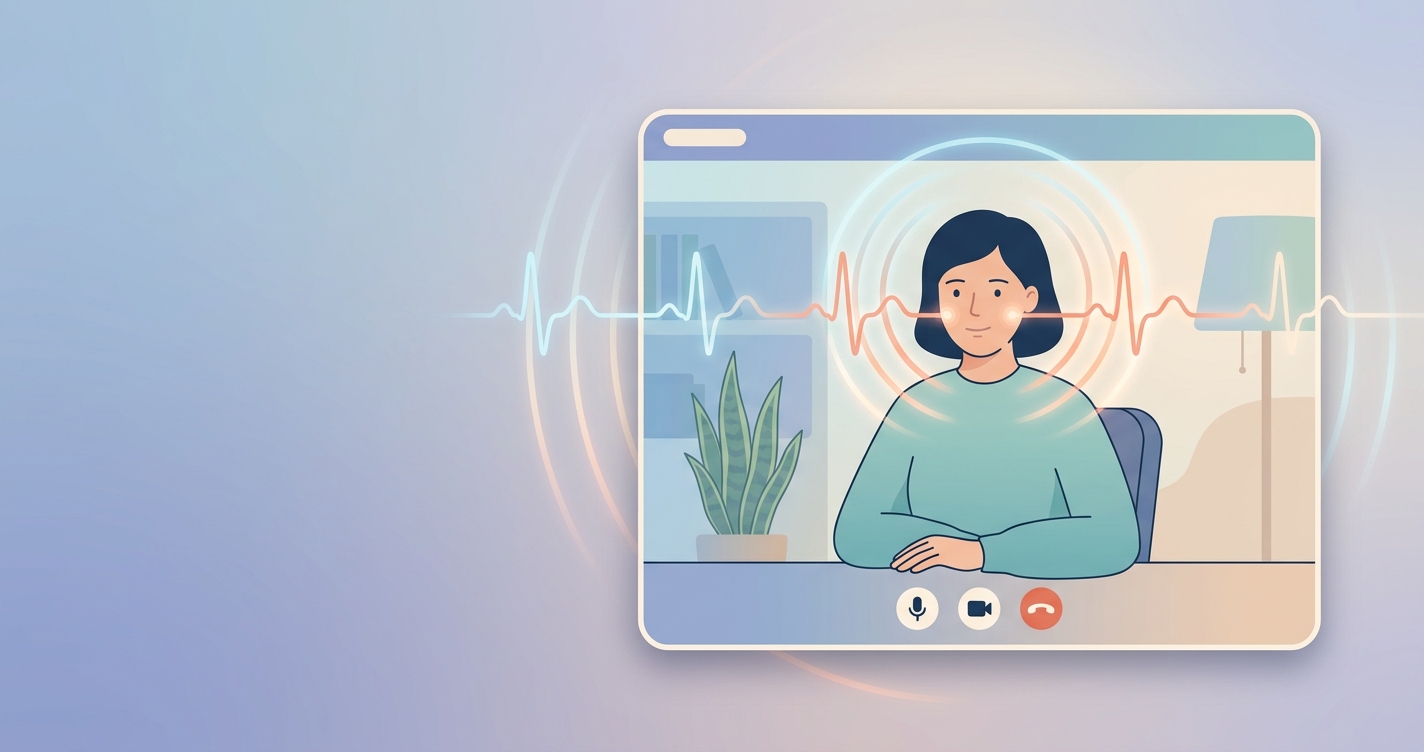
Behavioral health was the fastest service line to move online, yet it remains the one with the thinnest objective data. A therapist on a video call can read tone, facial expression, and word choice, but the autonomic signals that quietly track a patient's stress response have stayed invisible. That gap is now closing. The question of how a virtual therapist can check stress levels from home tonight is no longer hypothetical for virtual care program directors building out behavioral health services. It points to a measurable physiological marker, heart rate variability, that an ordinary camera can capture during the session itself.
"Remote photoplethysmography is considered a future tool for telemedicine, facilitating remote health monitoring for conditions including chronic disease and mental health, with deep learning approaches reaching high stress-detection accuracy in controlled studies.", synthesis of findings from a 2023 review on rPPG and deep learning for stress detection, published in PMC.
Reading virtual therapist stress levels at home through heart rate variability
The autonomic nervous system reacts to psychological stress faster than a patient can describe it. When the sympathetic branch dominates, heart rate climbs and the tiny beat-to-beat timing differences compress. When the parasympathetic branch recovers, those intervals widen again. Heart rate variability (HRV) is the measure of that timing spread, and decades of psychophysiology research treat it as one of the more reliable proxies for stress and emotional regulation.
The breakthrough for telehealth is that HRV no longer requires a chest strap or a finger clip. Remote photoplethysmography, or rPPG, reads subtle color changes in facial skin caused by each pulse of blood beneath the surface. A standard webcam or phone camera captures these micro-fluctuations, and signal processing reconstructs the pulse waveform, pulse rate, respiratory rate, and the inter-beat intervals needed to compute HRV metrics. For a behavioral health program, this means a therapist can observe an objective stress signal during the same video window already used for the appointment, without shipping a device or asking the patient to own a wearable.
The clinical appeal is specific. A self-reported anxiety scale captures how a patient remembers feeling. A passively measured HRV trend captures how their body is responding in the moment, and how that response changes session over session.
How the measurement options compare
Virtual behavioral health teams generally weigh four ways to bring a physiological stress signal into a remote visit. Each carries different friction, cost, and integration implications for the health system.
| Method | Patient effort | Equipment cost to program | Captures HRV | Fits inside the video visit | | --- | --- | --- | --- | --- | | Self-report questionnaire | Moderate (recall-based) | Minimal | No | Yes | | Consumer wearable (patient-owned) | High (must own, wear, sync) | Variable, often patient-borne | Yes | No, asynchronous | | Clinical chest strap or finger sensor | High (setup each session) | Per-device hardware | Yes | Partially | | Camera-based rPPG | Low (sit in frame) | Software, existing camera | Yes | Yes |
The pattern that matters to a program director is the bottom row. Camera-based capture is the only option that pairs low patient effort with HRV measurement inside the visit and no per-patient hardware to procure, distribute, or support.
Key operational advantages for behavioral health services include:
- No dependency on whether a patient already owns or remembers to wear a device
- Consistent measurement conditions across a panel of patients
- A trend line that accumulates with every visit rather than relying on a one-time snapshot
- Reduced equity gaps, since the requirement is a camera rather than a paid subscription wearable
Known limitations that teams should plan around include:
- Accuracy degrades under poor lighting, heavy motion, or elevated heart rates
- Skin tone and camera quality variation must be validated across the patient population
- HRV is a contextual marker, not a standalone diagnosis of any mental health condition
Industry applications for behavioral health programs
Routine telehealth therapy sessions
In standard talk-therapy visits, a passive HRV reading gives the clinician a second data stream alongside the conversation. A patient who reports feeling fine while showing a sustained drop in HRV gives the therapist a reason to probe further. Over a course of treatment, the trend can corroborate or complicate subjective progress notes.
Integrated behavioral health in primary care
Many health systems are folding behavioral health screening into primary and specialty virtual visits. Capturing stress-related vitals during these encounters lets a primary care provider flag autonomic dysregulation and route the patient to behavioral health, without adding a separate device-based workflow.
Medication management and follow-up
For patients on medications that affect autonomic tone or anxiety, HRV trends captured at each remote follow-up offer an objective companion to symptom checklists. Program directors can standardize this capture so every prescriber sees the same metric in the same place in the chart.
Crisis and high-acuity triage
When a nurse or counselor conducts an urgent virtual assessment, an immediate physiological reading adds context to verbal triage. It does not replace clinical judgment, but it narrows the uncertainty that comes from audio and video alone.
Current research and evidence
The evidence base for contactless stress measurement has matured quickly. A 2023 review in PMC, "Enhancing Stress Detection: A Comprehensive Approach through rPPG Analysis and Deep Learning Techniques," reported that combining rPPG-derived signals with deep learning models produced high stress-classification accuracy under controlled conditions, while noting that real-world variability remains a challenge.
Broader reviews reinforce both the promise and the caveats. A 2023 PMC review on deep learning and rPPG for contactless physiological measurement described rPPG as a route to remote monitoring of pulse rate, breathing rate, and HRV, and identified mental health risk among the assessment targets. Work published in MDPI on pulse rate variability analysis from rPPG signals has examined how closely camera-derived inter-beat variability tracks the gold-standard electrocardiogram, which is the foundation any HRV-based stress signal depends on.
Researchers are consistent about the constraints. As reporting on rPPG performance has noted, accuracy can drop sharply at elevated heart rates, and illumination and motion artifacts remain the dominant error sources. Work on advancing rPPG for cardiac monitoring in naturalistic settings using webcam technology, published in PMC, has focused on closing exactly this gap between laboratory conditions and the messy reality of a patient sitting at a kitchen table. For a program director, the takeaway is that the science supports careful, validated deployment rather than blanket claims.
The future of contactless stress measurement in virtual care
The direction of travel is toward stress signals that are continuous, longitudinal, and native to the electronic health record. Three shifts are likely to define the next few years.
First, capture will become passive and ambient. Rather than a dedicated measurement step, HRV and related markers will be read across the natural arc of a session, smoothing out the motion and lighting noise that hurts single-snapshot readings.
Second, behavioral health metrics will move from isolated scores to integrated trends. A stress marker becomes far more useful when it sits next to medication changes, visit notes, and self-reported scales in one longitudinal view, letting clinicians correlate physiology with treatment events.
Third, governance and validation will mature. Health systems will demand population-specific accuracy testing across skin tones, devices, and bandwidth conditions before these signals inform clinical decisions, mirroring the validation discipline already applied to camera-based vital signs generally.
Frequently asked questions
Can a virtual therapist really measure my stress levels from home tonight?
A virtual therapist can capture physiological markers associated with stress, primarily heart rate variability, using camera-based rPPG during the video visit. This gives an objective signal alongside the conversation. It is a measurement aid, not a standalone diagnosis, and accuracy depends on lighting, stillness, and validated technology.
What is heart rate variability and why does it indicate stress?
Heart rate variability is the variation in time between consecutive heartbeats. Higher variability generally reflects parasympathetic recovery, while reduced variability is associated with sympathetic activation and acute stress. Because the autonomic nervous system responds faster than conscious awareness, HRV can reflect a stress state a patient may not yet be reporting.
Do patients need a wearable or special device for this?
No. Camera-based rPPG uses the webcam or phone camera already present in a telehealth session. There is no chest strap, finger sensor, or consumer wearable to purchase, distribute, or sync, which removes a common equity and adherence barrier for behavioral health programs.
How reliable is camera-based stress measurement?
Peer-reviewed studies show strong performance under controlled conditions, with accuracy reduced by motion, poor lighting, and very high heart rates. Reliability improves with longer passive capture windows and population-specific validation, which is why health systems should test these tools across their own patient mix before clinical use.
Circadify is building toward exactly this future for behavioral health, capturing clinical-grade vital signs, including the heart rate variability markers tied to stress, inside every virtual visit, with no patient wearables and direct EHR integration. To see the clinical workflows and request a health system demo, visit circadify.com/solutions/telehealth.