
Why would my virtual doctor want to see my face during our check-up tomorrow?
How a virtual doctor face check-up uses camera-based facial analysis to capture vital signs, explained for patients and clinical informatics teams.
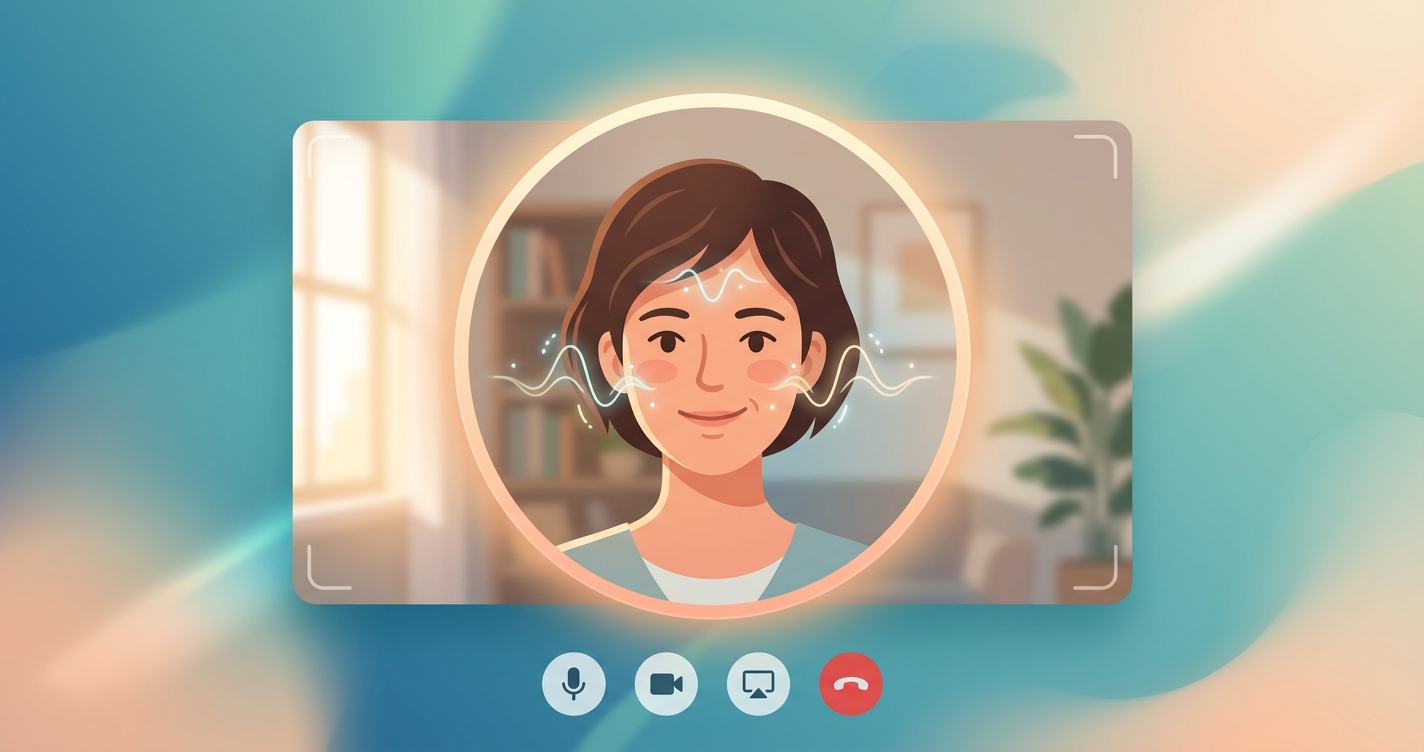
When a patient receives a reminder asking them to keep their camera on and their face well-lit for a video appointment, the request often reads as a simple courtesy. The clinical reality is more interesting. A virtual doctor face check-up increasingly does more than support conversation. The camera that captures a patient's expression can also read measurable physiological signals from the skin, turning a routine video window into a contactless vital signs sensor. For clinical informatics teams building patient education materials, explaining this clearly is the difference between a patient who sits still and cooperates and one who shifts, looks away, or dims the room at the exact moment data is being collected.
"rPPG-derived pulse rate showed strong agreement with ECG in cardiovascular disease patients, with a mean absolute error of 1.061 beats per minute," reported a 2024 clinical validation study published in MDPI Sensors.
What a virtual doctor face check-up actually measures
The technology behind a virtual doctor face check-up is called remote photoplethysmography, usually shortened to rPPG. Every time the heart beats, it pushes a fresh volume of blood through the small vessels just beneath the skin of the face. That pulse of blood subtly changes how much light the skin absorbs and reflects. The shifts are far too small for the human eye to notice, but a standard camera sensor records them frame by frame. Software isolates regions of the face with reliable blood flow, such as the forehead and cheeks, then analyzes the rhythmic color changes over time to reconstruct a pulse waveform.
From that waveform, the system can derive several clinically relevant measurements. The same video stream that shows a patient talking carries the data needed to estimate:
- Heart rate, from the frequency of the pulse waveform
- Respiratory rate, from the slower rise and fall in the signal caused by breathing
- Heart rate variability, the subtle timing differences between beats
- Pulse-related indicators that can support blood pressure and oxygen saturation estimates
This is why the face matters so much. The technique depends on visible, well-lit skin and a reasonably stable image. A patient sitting in a dark room, wearing a hat that shadows the forehead, or moving the phone constantly gives the algorithm a noisier signal to work with. The request to "see your face" is really a request for a clean optical signal.
How camera-based capture compares to familiar methods
Patients understand the cuff, the fingertip clip, and the chest electrodes. Framing rPPG against those familiar tools helps demystify what the camera is doing. The comparison below outlines the practical differences clinical teams can share with patients.
| Method | Contact required | Equipment at home | Typical use in virtual visits | Patient effort | |---|---|---|---|---| | Camera-based facial analysis (rPPG) | None | Smartphone or laptop camera | Heart rate, respiratory rate, HRV during the call | Sit still, good lighting | | Blood pressure cuff | Yes | Patient must own a cuff | Manual reading reported to provider | Self-apply, self-measure | | Fingertip pulse oximeter | Yes | Patient must own a device | Spot oxygen and pulse reading | Clip on finger | | Chest ECG electrodes | Yes | Specialized hardware | Rarely used in routine televisits | High, requires placement |
The central advantage for a virtual care program is that camera-based capture removes the dependency on patient-owned hardware. No cuff to buy, no clip to find in a drawer, no battery to charge. The sensor is already running because the visit is already on video.
Industry applications for clinical informatics teams
For the teams that design virtual care workflows, the value of explaining facial capture goes beyond patient comfort. Clear education changes data quality and downstream documentation.
Primary care and chronic disease check-ins
Routine follow-ups for hypertension, heart failure, and diabetes depend on trend data. When patients understand that a steady, well-lit face during the first 30 to 60 seconds produces usable vitals, the capture succeeds more often and the numbers flow into the chart without a repeat request.
Nursing triage and intake
A short facial capture during virtual intake gives a nurse objective numbers to pair with the patient's reported symptoms. Patient-facing instructions that explain why the camera stays on reduce the friction that slows triage queues.
Behavioral health and remote monitoring
Heart rate variability captured passively during a conversation supports stress and autonomic assessment without asking a patient to strap on a device. Education here is especially important, because patients should know the camera is reading physiology, not analyzing facial expression or emotion.
Current research and evidence
The evidence base for camera-based vitals has matured quickly. The foundational demonstration that ordinary cameras could detect the cardiac pulse from facial skin came from Wim Verkruysse and colleagues at the Beckman Laser Institute in 2008, who showed that ambient-light video contained a recoverable plethysmographic signal. The two decades since have been spent improving accuracy, robustness, and validation against clinical references.
Recent validation work is more directly relevant to virtual care. A 2024 study in MDPI Sensors evaluated rPPG software in cardiovascular disease patients and reported a mean absolute error of roughly 1.06 beats per minute against ECG. A separate 2024 validation of a contactless telehealth portal, published in the Journal of Medical Internet Research family of journals, found an average absolute difference of 1.41 beats per minute for heart rate and 0.86 breaths per minute for respiratory rate compared to reference measurements. Researchers have also shown that usable heart and respiratory rate estimates can be derived from recordings as short as 15 seconds, an important finding for the time-constrained reality of a video visit.
Researchers at the University of Oulu, a long-standing center for rPPG research, have published comprehensive reviews of heart rate and respiration estimation from facial video, documenting both the progress and the open challenges. Those challenges are consistent across the literature:
- Motion artifacts from a patient who moves or holds the camera by hand
- Variable lighting, especially low light or strong backlighting
- Performance differences across skin tones, an active area of algorithm fairness research
- Camera quality and frame rate variation across consumer devices
Understanding these limits is part of honest patient education. The goal is not to claim a camera replaces every in-person measurement, but to explain what it captures well and under what conditions.
The future of virtual doctor face check-ups
The direction of travel points toward capture that is faster, more passive, and better integrated into the clinical record. As algorithms grow more tolerant of movement and lighting, the explicit "hold still" moment may shrink or disappear, with vitals gathered quietly across the natural span of a conversation. Work on fairness across diverse skin tones aims to make the technology equally reliable for all patients, which is a prerequisite for enterprise-wide deployment in any health system serving a broad population.
The other frontier is integration. A measurement is only useful to a clinician if it lands in the chart with the right context. The next phase of adoption ties camera-based capture directly into virtual care platforms and the electronic health record, so a facial check-up produces structured, trend-ready data rather than a number a provider has to transcribe. For clinical informatics teams, that shift reframes the camera from a communication tool into a documented clinical instrument.
Frequently asked questions
Why does my virtual doctor want to see my face during the check-up?
The camera can read tiny color changes in the skin caused by your heartbeat and breathing. With a clear, well-lit view of your face, software can estimate your heart rate, respiratory rate, and related vital signs without any device touching you. Good lighting and minimal movement make those measurements more reliable.
Is the camera analyzing my emotions or facial expressions?
No. Camera-based vital sign capture measures physiological signals such as blood flow and breathing, not mood or expression. The face is used because the skin there has reliable blood flow that produces a clean optical signal.
How accurate is camera-based vital sign capture?
Recent 2024 validation studies report heart rate within roughly 1 to 1.5 beats per minute and respiratory rate within about 1 breath per minute of reference measurements under good conditions. Accuracy depends on lighting, stillness, and camera quality, which is why clear patient instructions matter.
Do I need any special equipment or a wearable?
No. The technique uses the camera already built into your smartphone, tablet, or laptop. There is no cuff, finger clip, or wearable required for the basic facial capture.
Circadify is building toward this space, helping health systems capture clinical-grade vital signs in every virtual visit without patient wearables and with direct EHR integration. Clinical informatics and virtual care teams who want to see the supporting clinical workflows can explore a health system demo at circadify.com/solutions/telehealth.