EHR Integration Patterns for Televisit Vital Signs Data
A health-system analysis of EHR integration televisit vitals patterns across HL7, FHIR, workflow design, and data governance.
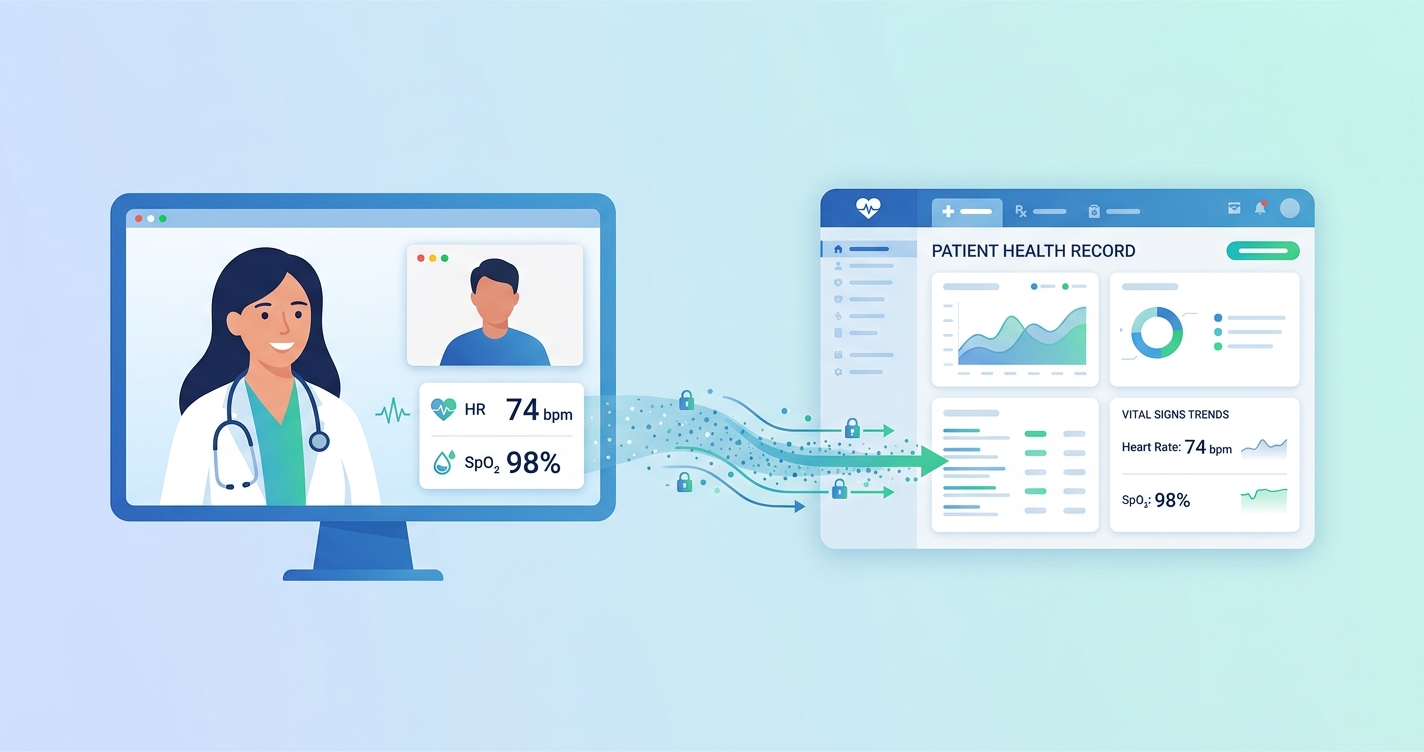
EHR integration televisit vitals has become a practical architecture question for health systems, not a speculative one. Once virtual care leaders decide that camera-based heart rate, oxygen saturation, and related measurements should become part of remote encounters, the next decision is where those data land, how fast they appear, and whether clinicians can trust them inside normal charting workflows.
"The FHIR Vital Signs profiles set the minimum expectations for the Observation resource to record, search and fetch the vital signs associated with a patient," the HL7 FHIR specification states. That framing matters because remote vital-sign capture only becomes useful at enterprise scale when the measurements are structured, queryable, and attached to the encounter that generated them.
EHR integration televisit vitals usually starts with the observation model
The cleanest way to think about this topic is to separate capture from integration. Capture happens in the virtual visit. Integration determines whether the result behaves like clinical data afterward.
For most health systems, the core design questions are straightforward:
- does the data arrive as HL7v2 results, FHIR Observation resources, or a proprietary platform feed?
- is the measurement linked to the correct patient and virtual encounter?
- does the EHR store it in standard vital-sign structures or in an isolated custom table?
- can downstream workflows reuse it for documentation, review, and analytics?
The HL7 FHIR vital-signs guidance is explicit that a compliant Observation includes status, a category code of vital-signs, a patient, the time of measurement, and a numeric result with standard UCUM units. For heart rate, the high-level interoperability code is LOINC 8867-4. For oxygen saturation, the specification points to LOINC 2708-6 and notes that the more specific 59408-5 code may be used when appropriate.
That standards layer is what keeps virtual visit data from turning into a one-off workflow artifact.
| Integration pattern | Typical transport | Main strength | Main tradeoff | Best fit | |---|---|---|---|---| | HL7v2 ORU feed | Interface engine message | Works with mature hospital integration stacks | Less expressive metadata than full FHIR resources | Large systems with established result interfaces | | FHIR Observation write | REST API with OAuth | Strong semantic structure and cleaner reuse | Requires modern API governance and app registration | Systems investing in standards-based interoperability | | Proprietary EHR API | Vendor-specific endpoint | Can map tightly to native workflows | Harder to keep portable across platforms | Single-platform enterprise deployments | | Telehealth-platform middleware | Existing platform integration layer | Fastest path when virtual care stack already connects to EHR | More dependency on an intermediary vendor layer | Programs standardizing on one virtual care platform |
HL7v2 remains the practical default for many health systems
A lot of enterprise teams still begin with HL7v2 because it fits the operating reality of hospitals. Integration engines, message monitoring, exception routing, and downstream chart interfaces are already built around result delivery.
In that pattern, televisit vital signs typically arrive as ORU messages with patient identity in PID, encounter context in PV1 when available, and observation details in OBX segments. For clinical informatics teams, the hard work is not the transport itself. It is the mapping discipline around codes, units, timestamps, and result status.
HL7v2 also tends to be attractive when leadership wants fast rollout across departments because:
- interface teams already know how to test and monitor ORU traffic
- EHR analysts are familiar with inbound results workflows
- message failures can be routed through existing operational support processes
- latency is usually adequate for near-real-time virtual visit documentation
The tradeoff is that HL7v2 often needs more local convention to preserve details such as measurement method, device provenance, or quality indicators.
FHIR Observation patterns are gaining strategic importance
FHIR-based integration is often the better long-term pattern when a health system wants remote vitals to behave like reusable, standards-native data. The HL7 specification emphasizes that vital-sign Observations should carry the patient, time, category, code, and standardized units. That structure becomes valuable when data need to support retrieval, apps, dashboards, and longitudinal review rather than just one inbound chart update.
Oracle Health's Millennium Platform documentation is a useful signal here. Its FHIR R4 Observation create API explicitly supports vital-signs as a category, requires effectiveDateTime, subject, status, and valueQuantity, and notes support for creating new observations through the /Observation endpoint. The same documentation also supports encounter linking and performer fields, which matters when health systems want the data tied clearly to a remote episode of care.
Agent-search results on Epic's FHIR ecosystem also confirmed that Epic supports FHIR-based handling for Observation resources and vital-sign workflows. Even when the exact implementation details vary by environment, the larger point is now stable: major EHR vendors have moved standards-based vital-sign exchange into the mainstream.
For architecture teams, that makes FHIR appealing when priorities include:
- preserving structured metadata about how the reading was captured
- supporting future analytics and app-layer reuse
- reducing local customization compared with legacy result interfaces
- aligning virtual care workflows with broader interoperability strategy
The encounter link matters more than teams expect
One of the easiest ways to weaken a remote-vitals program is to store the measurement without strong encounter context. If the reading reaches the chart but is not clearly associated with the televisit that produced it, providers may still treat it as partial or ambiguous documentation.
That is why better EHR integration designs make sure the televisit measurement is attached to:
- the patient identity with reliable matching logic
- the encounter reference for the virtual visit
- the exact measurement time, not just interface receipt time
- the clinical source or method metadata
Those details sound technical, but they shape provider trust. A number on the chart is not enough. Clinicians want to know whether the measurement belongs to this visit, this patient, and this moment.
Why interoperability quality affects telehealth outcomes
The architecture conversation is not separate from care outcomes. Agent-search research on the paper Impact of Electronic Health Record Interoperability on Telehealth Service Outcomes found that interoperable EHR environments help telehealth workflows support value-based and team-based care, reduce data silos, and improve care coordination. That is exactly the operational logic behind integrating remote vital signs into the chart instead of leaving them inside a telehealth app alone.
The same pattern shows up in adjacent literature. Research cited through agent-search around blood pressure documentation during telehealth visits found that quality performance often weakened when the measurement layer dropped out of the workflow, not because telehealth itself was inherently inferior. In other words, the integration pattern can determine whether the virtual visit remains clinically complete.
Industry applications for different integration patterns
Enterprise health systems with mature interface teams
These organizations often begin with HL7v2 because they already run high-volume result interfaces through a central engine. The priority is scale, operational familiarity, and supportability.
Digital front-door and API-first programs
Systems investing in modern interoperability programs usually prefer FHIR Observation writes because the data can be reused across patient apps, virtual-care layers, and analytics services more easily.
Multi-vendor virtual care environments
When the telehealth front end, scheduling layer, and EHR all come from different vendors, middleware becomes the practical bridge. In those cases, the goal is less ideological purity and more reliable routing, monitoring, and normalization.
Clinical informatics-led pilots
Pilots often start with the integration path that gets results visible in the chart fastest. The important next step is not to freeze there. Informatics teams usually need a second-phase plan for standardization, metadata enrichment, and enterprise reporting.
Current research and evidence
Several current sources point in the same direction.
- The HL7 FHIR vital-signs specification says the Vital Signs profiles set the minimum expectations for recording, searching, and fetching vital signs in the Observation resource, with required elements such as
category, patient, time, and standardized units. - The same specification identifies LOINC 8867-4 for heart rate and 2708-6 for oxygen saturation, giving clinical informatics teams a stable standards baseline for mapping televisit data.
- Oracle Health's FHIR R4 Observation documentation shows that major EHR platforms support creating vital-sign observations through standards-based APIs with fields for category, code, effective time, encounter, subject, performer, and valueQuantity.
- Agent-search findings on Epic's FHIR environment likewise support the conclusion that Epic organizations can pursue Observation-based vital-sign integration patterns rather than relying only on legacy interfaces.
- Agent-search findings from Impact of Electronic Health Record Interoperability on Telehealth Service Outcomes indicate that interoperable EHR systems can improve telehealth care coordination, reduce fragmentation, and support the broader quadruple aim framework.
Taken together, that evidence supports a grounded conclusion: the technical pattern matters because it determines whether televisit vital signs become reusable clinical infrastructure.
The future of EHR integration for televisit data
The next phase is likely to be less about whether remote vitals can be written into the chart and more about how consistently they are normalized across service lines, sites, and vendors.
Expect mature programs to move toward:
- stronger use of FHIR Observation and related provenance metadata
- clearer harmonization between virtual visit data and RPM data
- more quality flags and confidence indicators at the data-model level
- broader reuse in decision support, population health, and virtual care analytics
That is also why this topic matters commercially without turning into a product pitch. Health systems want virtual visits to carry more structured clinical signal. Solutions like Circadify are entering a market where the real differentiator is not just capturing a number on camera, but integrating that number into the record in a way that fits enterprise workflows.
Frequently asked questions
What is the most common EHR integration pattern for televisit vital signs?
For many health systems, HL7v2 ORU messaging is still the most common starting point because it fits existing interface-engine operations and result workflows.
Why is FHIR important for EHR integration televisit vitals?
FHIR matters because the Observation model preserves structured context around the reading, including patient, time, category, code, and units. That makes the data easier to reuse across workflows and analytics.
Should remote vital signs be stored in standard vital-sign fields?
Usually yes. If the data are stored in standard clinical structures rather than isolated custom locations, providers can review them in normal chart workflows and organizations can use them in reporting and quality programs.
How should health systems choose between HL7 and FHIR?
The choice usually depends on current infrastructure, implementation speed, API maturity, and long-term interoperability goals. Many organizations begin with HL7v2 for speed and move toward richer FHIR patterns over time.
Related reading on this site: Televisit Vital Signs: A Guide for Clinical Informatics Teams, Clinical Workflows for Camera-Based Vitals in Televisits, and How Virtual Care Programs Measure Clinical ROI of Vitals Capture.